

 Stumble It!


The MSM, drive-by-media traitors are at it again. CNN embeded with terrorist snipers? video-taping the assassination of US troops? Try them. Execute them. At the very least revoke their visa's and deport them. Am I alone here? A Traitor is a Traitor, no?...T
With this post about Marine 2nd Lt. Joshua Booth, a sniper victim, Gateway Pundit captures the widespread revulsion at CNN's decision to air enemy propaganda, which it admits is enemy propaganda: a terrorist sniper killing an American. Wolf Blitzer lamely attempted to explain to House Armed Services Committee Chairman Duncan Hunter yesterday that CNN blacked out the frames where the GI gets hit and goes down. Hunter wasn't buying it, and neither are the vast majority of Americans.
CNN has thus triggered not an October surprise but an October surmise: We are in a war but elite media and much of the Democratic Party is indifferent to victory in that war, and genuinely incapable of regulating themselves and their behavior so as to maximize the chance of victory. Now a leading network is airing a snuff film from the terrorists, which follows a year in which newspapers have compromised both our electronic surveillance of terrorists communicating with their operatives in the US, and our tracing of terrorist money flows, stories which in both instances undeniably assisted terrorists in eluding capture.
The enemy is trying for a Ramadan version of the Tet offensive, and generally succeeding because even as was the case in 1968, the media and the left have no desire to understand much less report on the reality of the enemy and their tactics, but is instead in love with the idea of American defeat. Nancy Pelosi announces on 60Minutes that her goal is to make Bush and Cheney "lame ducks." There's a platform for you: The Party of Paralysis at Home and Defeat Abroad, supported by a MSM committed to showing the enemy's best side and our worst.
The Tet offensive claimed 4,324 killed, 16,063 wounded, and 598 missing among U.S., South Vietnamese and South Korean forces. Approximately 45,000 of the enemy were killed, and their offensive shattered. The communist butchery was vast, and in the city of Hue alone, 2,800 were murdered and another 2,000 went missing. The Viet Cong were in fact shattered, but that message never got home to America.
The enemy in fact won an enormous propaganda victory, including the famous photograph of General Nguyen Ngoc Loan executing a Viet Cong prisoner in Saigon. On February 27, 1968, Walter Cronkite presumed to throw in the towel for America, and the seeds of the genocide of a few years later were sown.
Now there is a Tet sequel underway, and the same players --the elite media and the Democratic Party-- want the same ending: Another quick exit and another long bout of self-flagellation over the limits of American power.
This time, though, the enemy will not stay in the land we leave. 9/11 showed us that, and if you want the details, consult Lawrence Wright's The Looming Tower.
It was possible for Democrats and the MSM to claim in the late '70s that they had no idea what we had abandoned southeast Asia to.
No such claim can be made about the aftermath of a defeat in Iraq or anywhere in the war against Islamist fascism.
Our eyes are wide open, watching terrorist snipers gunning down America's finest, and reading state secrets on the front page.
Click here for full article
Tuesday, October 24, 2006
CNN and the October Surmise
Democrats Post Election Plans: Revealed!
ZUCKER UNCENSORED TAXMAN AD
Democrats post-election plans revealed...shhh!...T
'06 ELEX: BACK TO TOSS-UP, from the Worst skeptic!
More in the same vein of what I have been posting...and this from Dick Morris of all people, who had been predicting a Demo sweep for weeks, if not months, until now!...T
October 24, 2006 -- The latest polls show something very strange and quite encouraging is happening: The Republican base seems to be coming back home. This trend, only vaguely and dimly emerging from a variety of polls, suggests that a trend may be afoot that would deny the Democrats control of the House and the Senate.
With two weeks to go, anything can happen, but it is beginning to look poss- ible that the Democratic surge in the midterm elections may fall short of control in either House.
Here's the evidence:
.......
Click here for full article
Friday, October 20, 2006
The undertow has arrived
Ok, enough speculation. Let's talk numbers, raw data. You still think a huge Dem sweep is coming? Read on, my friends, you won't be sorry...T
My new Townhall.com column is here, and my new World Magazine column is here.
Both relay the results of my reporting from four battleground states --Minnesota, Colorado, Pennsylvania and Ohio-- over the past five days. There isn't credible evidence of a significant depressed turnout among Republicans generally or evangelicals specifically. Lots of quotes from lots of self-annointed experts on turnout, and lots of secret sauce in the polling models, but no evidence of actual base voters deciding to stay home. Much contrary evidence in terms of metrics achieved and sampling of crowds and candidates.
Though the polls are all over the place, I note the latest on Tom Reynolds' race in New York's 26th CD. SurveyUSA now has Reynolds up three.
And Rasmussen puts Burns within 3 of Tester.
Three weekends of GOTV and 18 days of campaigning left, and the Dem surge is fading fast. Talk is cheap. GOTV is expensive. The Dems have the former, the Republicans the latter.
UPDATE: Doug Ross has the ilustrated guide to a Pelosi Speakership.
UPDATE: A Memo from Mehlman on the subject:
In recent days and weeks, the mainstream media have repeatedly claimed that the Republican base is suffering from "low voter enthusiasm." It is easy to believe a story that is repeated so frequently, but in fact there is ample evidence to the contrary. By many measures, there are strong indications of a right-of-center base that is engaged and committed.
First, numerous polls clearly indicate near parity in intensity between Democrats and Republicans. Three recent national surveys-Gallup, Cook/RT Strategies, and our most recent RNC survey conducted by Voter/Consumer Research-all show partisan interest is approximately equal. The details of those polls are below:
Voter/Consumer Research (Oct. 8-10)
The RNC's internal research shows election interest at 7.7 on a 10-point scale among Republicans and 7.6 among Democrats, unchanged from late September and in line with this year's overall trend.
Gallup (Oct. 6-8)
To quote from Gallup's voter turnout projection, "Gallup's latest analysis suggests Republicans and Democrats are now roughly even in terms of anticipated turnout in the midterm congressional elections. The voting intentions of the large pool of registered voters is now similar to the voting intentions of the smaller pool of likely voters, showing no disproportionate impact of turnout in either direction"
Gallup asked, "How motivated do you feel to get out and vote this year -- extremely motivated, very motivated, somewhat motivated, not too motivated or not at all motivated?(% "extremely" or "very" motivated)" The following table shows that the GOP in fact now holds a slight lead, up from just a few months ago:
....................................GOP DEM NET
Sept 15-17, 2006 .......... 70% 67% +3
Jun 23-25, 2006........... 74% 77% -3
Oct 3-6, 2002............... 65% 55% +10
Oct 29-Nov 1, 1998....... 59% 57% +2
Oct 23-25, 1998............ 67% 56% +11
Oct 9-12, 1998.............. 59% 53% +6
Sep 23-24, 1998........... 73% 62% +11
Cook/RT Strategies (Oct. 5-8)
On a scale of one to 10, Republicans and Democrats have almost equally high mean election interest scores (8.2 for Republicans, 8.1 for Democrats), but Democrats hold a slight edge in the percentage of their voters who are "highly interested"-47 to 51 percent.
However, keeping in mind the local nature of midterm elections, it is more important to consider intensity by state or congressional district. RT Strategies/Constituent Dynamics (conducted Oct. 8-10) released district-by-district polling showing Republicans have a slight edge in partisan intensity. GOP "voter motivation" is higher than Democratic motivation in 19 of 32 competitive House races, in some cases by as much as a full point on a 1 to 9 scale. Democratic intensity is higher in the remaining 13, and in none of those races is the difference higher than 2/3 of a point.
Additional Data
A recent Pew study (9/21-10/4) found that while roughly similar numbers of Republicans (41%) and Democrats (39%) are "regular" voters, more Republicans (25%) than Democrats (20%) vote intermittently--meaning there are more of our voters for us to turn out in a midterm election. Furthermore, Democrats (20%) are substantially more likely than Republicans (14%) to not be registered to vote at all.
Other Measures of Intensity
There are ways besides polls to measure the intensity of the Republican base, and those also indicate that GOP voters are strongly engaged. Fundraising, for example, is often called the "first ballot" for the simple reason that supporters only donate when they are involved and enthusiastic. That is why we are excited that the RNC received support from 362,000 new donors this cycle. We've averaged 8,256 contributions for each deposit day so far this year. We just announced that September has been our best financial month of the entire cycle. Our supporters know how important this election is, and their financial support shows it.
Volunteer enthusiasm is another key measure of intensity. Again, every indication here is that our base is working hard for victory in the 2006 election. Republican volunteers have contacted more than 14 million voters this year, and more than 7 million since Labor Day alone. We have made 1 million voter contacts every week for the past five weeks, and for six weeks we have surpassed the number of contacts we made at comparable times in 2004, a presidential election year.
The Bottom Line
Despite the media hype, an examination of all the facts makes it clear: the Republican base is active and engaged. No matter how you measure it--whether by record-breaking fundraising, unprecedented volunteerism, or scientific polling--the numbers show that Republicans understand the importance of the choice we all face on November 7.
Click here for full article
Sunday, October 15, 2006
White House Upbeat About GOP Prospects
Now, I believe that, in every election in the past several decades, congressional races have significantly under-polled the Republicans. This happened most recently in 2000, 2002, and 2004. These facts are undeniable. Why should this year be any different? I trust the opinions of the experts I have been posting, here, much more than Gallup, or Zogby, who have been proven partisan in the last several election cycles. I trust the men quoted herein a great deal more than the blathering, simpering, rabidly drooling, Drive-By-MSM...T
Amid widespread panic in the Republican establishment about the coming midterm elections, there are two people whose confidence about GOP prospects strikes even their closest allies as almost inexplicably upbeat: President Bush and his top political adviser, Karl Rove.
Some Republicans on Capitol Hill are bracing for losses of 25 House seats or more. But party operatives say Rove is predicting that, at worst, Republicans will lose only 8 to 10 seats -- shy of the 15-seat threshold that would cede control to Democrats for the first time since the 1994 elections and probably hobble the balance of Bush's second term.
In the Senate, Rove and associates believe, a Democratic victory would require the opposition to "run the table," as one official put it, to pick up the necessary six seats -- a prospect the White House seems to regard as nearly inconceivable.
The Mark Foley page scandal and its fallout have many Republicans panicked, but Rove professes to be taking it in stride. "The data we are seeing from individual races and the national polls would tend to indicate that people can divorce Foley's personal action from the party," he said in a brief interview Thursday.
The official White House line of supreme self-assurance comes from the top down. Bush has publicly and privately banished any talk of losing the GOP majorities, in part to squelch any loss of nerve among his legions. Come January, he said last week, "We'll have a Republican speaker and a Republican leader of the Senate."...continued
Click here for full article:
A Voice of Sanity
Amen, and let's hope it is so....T
A Voice of Sanity, That's Donald Lambro, who surveys the electoral scene and sees the Republicans with strong issues to take to the voters:
President Bush and his party have made it clear that the final weeks of the elections will be about two issues: national security and the economic recovery.
The war in Iraq, and our efforts to help the Iraqis' fledgling democracy overcome its terrorist insurgency, is the administration's biggest political challenge right now. Still, polls show a 51 percent majority believes Iraq is a key battle in the war on terrorism, and most Americans, 50 percent to 42 percent, say the country is safer today than it was before Sept. 11.
Meanwhile, a growing economy is fast emerging as a big political plus for Bush and his party that they intend to promote for all it's worth.
In any normal election cycle, a booming economy and an edge on national security would be considered a winning hand. But this year, the hysteria that the Democrats and their allies in the news media have generated has swept away all rational consideration of the issues. If you believe the newspapers, that is, and to some degree the polls.
As I've said before, I assume the Republicans will lose seats in November, and the Democrats may well wrest away control of one or even both houses. Still, I wonder: the news media have gone stark, raving mad over Mark Foley's emails, and generic preference polls seem to indicate that the Foley "issue"--whatever it is--has helped the Democrats. But, to the extent that people are offended (as they should be) by homosexual Congressmen hitting on teenage boys, does anyone seriously believe that the solution is to elect Democrats? I doubt it. Democrats are far more associated with both homosexuality and sexual misbehavior than Republicans.
Likewise with the economy. The media have tried to minimize our current prosperity. But can they really succeed in doing that, when people see the prices at which homes in their neighborhood sell, watch prices fall at the gas pump, and enjoy both salaries and stock markets indices that are the highest on record? More and more Democrats are coming out into the open about their intention to raise taxes. How many voters believe that is the way to maintain our current prosperity? Very few, I think.
Newspapers love to headline "More Abuse Alleged at Gitmo!"--more about that later--and Democrats seem to think "detainee abuse" is a winning issue for them. Well, maybe.
But most Americans understand that when we capture a member of al Qaeda who has knowledge of that organization's plans, potentially including imminent attacks and the whereabouts of other members, it is important to question that detainee quickly and find out what he knows. There is a clear consensus that torture is not an acceptable tactic. But the Democrats and the newspapers consider pretty much everything to be "torture." Most Americans realize that we can't get information from a terrorist by saying "pretty please." What, exactly, are we supposed to do to protect American lives? The Democrats have no answer. Likewise, if we are to house detainees at a facility like Guantanamo Bay, or any other facility, the guards must have a reasonable degree of control over the prisoners. The prisoners frequently attack guards and misbehave in other ways. Once again, does anyone seriously think that all a guard has to do is ask a detainee to please get back in his cell?
This is the most topsy-turvy election season in memory, with trivia largely predominating over the very serious issues that divide the parties. The media's full-court press may well succeed in pushing the Democrats over the finish line. Still, it would be odd for voters to completely ignore the fundamentals of economics and national security that normally drive elections. Which, I think, is one of the reasons for the hysterical tone of today's news coverage.
Click here for full article
Friday, October 13, 2006
Are the Democrats Whigging Out?
In an very prescient article, this piece lays out what I have been predicting for some time now, namely, that the democrats have no where to go, politically and ideologically. The break up of their party, demographically, is the most likely outcome in the long term, and even possible in the near future...T
Predicting what will happen if the Democrats win control in one or both houses of Congress next month is a burgeoning cottage industry. It is, however, both more interesting and probably more useful to consider what will happen if they don’t.
If Democrats win they will crow and bray and make nuisances of themselves with frivolous, ankle-biting investigations. They may even connive with the White House and some foolish Republican legislators to enact “comprehensive immigration reform.” If they do, the principal effect will be to turn our illegal immigration problem into a crisis, creating a major political opportunity for the next generation of GOP leaders. Aside from that, very little will change.
Democrats are too conflicted and too politically timid to force any significant change in the Bush administration’s foreign and defense policies. They frittered away their dominant position in American politics by procuring the Ford administration’s surrender in Vietnam. Ever since, they have been crippled by the widespread (and entirely accurate) perception that they are not to be trusted with our national security. They may belong, body and soul, to the lunatic left, but most of them are not about to step over the same cliff twice.
In any case, having stepped over that cliff in the 70’s, the Democrats are very unlikely to win either house of Congress in 2006. The American people may loathe the Republican Party every bit as much as the Washington Post thinks they do, but nothing in our history suggests that a majority of American voters is crazy enough to trust Democrats with significant power during a war.
The headlines of the moment are orchestrated to create the appearance that a Democrat restoration is at hand. After the news industry has prepared them for victory in the run up to three consecutive electoral defeats, the Democrats should be wary. Many, probably most, of them are not. They have made the mistake of believing their own propaganda yet again.
In the likely event that Democrats wake up on the Wednesday after the first Tuesday in November and find that the federal government is firmly in Republican hands for another two years how will they react? After licking their wounds by dabbling in deranged conspiracy theories about election fraud, they will fall to fighting among themselves like starving sled dogs. There will be casualties. Howard Dean, Nancy Pelosi and Harry Reid will all have trouble keeping their jobs in the wake of yet another failure.
In the ensuing succession struggles the deep divisions in the Democrat Party will be laid bare. Some Democrats will claim that the party must take the war more seriously and appear more moderate to win. Others will argue that the party must be true to its ideological roots on the far left so that it may win a majority by the power of passion and persuasion. Neither side of this debate will grasp the true nature of the Democrat dilemma.
The would-be moderates don’t understand that Democrats can’t win without the left. The ideological purists don’t understand that Democrats can’t win with it.
If the Democrats ceased to be the leftist party they would lose their all-important propaganda apparatus in the heirloom media. They would lose all their intellectual firepower (such as it is) in the universities and all the cachet of Hollywood. Their fundraising base would disappear. They would become a me-too party relegated to winning elections in most of the country only when the Republican candidate got caught in bed with either a live boy or a dead girl.
As essential as the left is to Democrats, it can’t muster anything approaching a nationwide majority. This is hardly surprising. The left is anti-American and most Americans aren’t.
The left is defined by it’s loyalty to a trans-national ideal. Nation states in general and the United States in particular are obstacles to the realization of that ideal. Whenever the interests of the United States and the ideological purposes of the left conflict, which is often, American leftists work against their own country.
Consider, for example, the grotesque foolishness of Kyoto and the left’s determined efforts to undermine our ongoing war for national survival. Even the dimmest voter can smell the contempt leftists have for ordinary people and for everything they hold dear. The more voters understand that Democrats are the political wing of the American left, the fewer votes they will cast for Democrats.
Professional Democrats have tried for years to have their cake and eat it too. They have tried to keep the loyalty of the left without getting identified with it. That worked during the ersatz peace of the Clinton years when they were still winning, at least sometimes.
The pressure of war and defeat has made it much more difficult for Democrats to have it both ways. They have tried desperately to straddle the divide between those who want to defend America from our deadly enemies and those who don’t. John Kerry made an ass out of himself trying to bridge that gap and then discovered that Americans don’t really want an ass in the White House.
Since Kerry went down in flames, canny Democrats have tried to say very little about the war but to say it as indignantly as possible. They have been in tune with the left’s anger without overtly adopting its politically poisonous defeatism. This tightrope act isn’t likely to work for them any better than Kerry’s contortions did.
After yet another defeat even the Democrats may finally grasp that they can’t have it both ways. They can follow Joe Lieberman’s path and stand for American interests at the price of parting ways with about half their voters. They can also follow Ned Lamont and stand up for the left at the price of losing the other half. Either choice would mean that the Democrat Party could no longer seriously contend for a share of power in national elections.
This isn’t the first time a major American political party has been closely divided over a defining issue. The Democrats’ dilemma in 2006 looks a lot like the Whigs’ dilemma in 1852. The Whigs depended on support from both slave holders and abolitionists. They tried to straddle the slavery issue but they couldn’t. Their party broke apart and disappeared.
The Democrats have much deeper roots than the Whigs, who lasted only 24 years. They are likely to linger in some form for quite some time. But one more unexpected defeat just might tear them apart and prompt a dramatic political realignment.
At some level, Democrats seem aware of this danger. They are fighting the 2006 campaign like the existential struggle which, for them, it may very well be. It smacks of desperation, to choose an example at random, when the party of pederasty attacks Republicans for failing to condemn a homosexual congressman in advance of any evidence that he did anything wrong.
The political game has never been a better spectator sport and the stakes have rarely been higher.
Click here for full article
Tuesday, October 10, 2006
The David Zucker Albright Ad
The David Zucker Albright Ad. I'd run this one all day, in a heartbeat. It's true, after all. They run adds acusing Bush of lynching black men, run stories fabricated on CBS, and spread rumors acusing Bush of fabricating the 9/11 attacks. Run the add!..T
Saturday, October 07, 2006
A Tale of Two Ads: The real choice this November
"It shocks the conscience. Congressional leaders have admitted covering up the predatory behavior of a congressman who used the Internet to molest children. For over a year, they knowingly ignored the welfare of children to protect their own power. For 17 years, Patty Wetterling has fought for tougher penalties against those who harm children. That's why she's demanding a criminal investigation and the immediate expulsion of any congressman involved in this crime and coverup."
--TV ad on behalf of Patty Wetterling, Democratic candidate in Minnesota's 6th Congressional District
"A call is placed from New York to a known terrorist in Pakistan. A terrorist plot may be unfolding. Should the government intercept that call or wait until the paperwork is filed? Nancy Johnson says: 'Act immediately. Lives may be at stake.' Liberal Chris Murphy says: 'No. Apply for a court warrant even if valuable time is lost.' Chris Murphy -- wrong on security, wrong for America."
--TV ad on behalf of Nancy Johnson,Republican candidate for reelection in Connecticut's 5th Congressional District
There you have it. These TV ads in two competitive House races tell the story. Repelled by former Republican congressman Mark Foley's sexual overtures to congressional pages and ex-pages, and by the House GOP leadership's alleged failure to move aggressively against him? Vote Democratic. Worried about the Demo crats' tendency to coddle jihadists? Vote Republican.
This is a choice that should work out fine for Republicans. Which is why Democrats and the media may look back on the frenzy about Foley as a tactical mistake. In a time of disturbing foreign news--apparent lack of progress in Iraq, North Korea's threat of a nuclear test, Pakistan's cutting a deal with al Qaeda, Iran's nuclear program chugging ahead--the assault on the Republicans focused on a disgraced and departed congressman and the unquestionably decent speaker of the House, Denny Hastert.
Foley is a creep. The House leadership might have stumbled in dealing with him. But even the Washington Post commented that Wetterling's ad "seriously overstates what is known about the actions of the House Republican leadership." Will voters really be convinced that Denny Hastert "knowingly ignored the welfare of children to protect [his] own power?" From what we know, Hastert didn't find out about Foley's lurid behavior until a week ago, and then Foley was quickly gone. And how exactly did ignoring Foley's behavior help protect GOP power? His district is a safe Republican seat (except now, when Republicans are stuck with Foley's name on the ballot).
The attempt to make Foley a key issue in this fall's election is flopping. It's not credible to tar a political party with the misdeeds of one person. Did Republicans, for example, even try to link Gary Condit to other Democratic candidates in 2002? Was anyone really interested in Condit's party affiliation? Of course not.
And voters aren't in Foley's. National polls taken last week were basically unchanged from pre-Foley polls--bad for the GOP, but not irredeemable. And in the two competitive House races in Florida districts near Foley's, where there was of course saturation coverage of the story, the Republican candidates happened to gain ground last week.
There's no roll call vote in which the parties split on the behavior of Mark Foley. But there have been recent votes in which the parties divided on terror interrogations and (in the House) eavesdropping. On interrogations: Virtually all Republicans voted for tough interrogations of terrorists, and more than three-quarters of Democrats voted against. On supporting the administration's program of warrantless surveillance: Republicans in the House voted 214-13 for, Democrats 177-18 against. The Nancy Johnson advertisement may oversimplify things, but it captures a basic difference between the parties. That's why it has been effective. Johnson has opened a sizable lead on her opponent since the ad started running.
Issues usually trump scandals. Americans like reading about scandals. They like watching Desperate Housewives. But voting is different from voyeurism. The Republican landslide of 1994 was helped along by earlier congressional scandals--but it was basically ideological, following a campaign focused on Clinton's health care plan, his tax hike, gays in the military, gun control, and the like.
After a few days of panic last week, House Republicans seem to have calmed down and to be dealing more effectively with the Foley aftershocks. Now they need to defend against the charge that they don't care about sexual predators, and attack the Democrats for unjustly impugning their honor. Then they can get back to the issues--terror and taxes--where the parties really are distinct.
And if the media and the Democrats want to remain sex-obsessed? It might not be amiss for Republican candidates to remind the electorate which of the two parties has, shall we say, a more "nuanced" view of sexual scandal. Which party continued to accept Rep. Gerry Studds as a member in good standing for a decade after his sexual liaison with a 17-year-old page? Which party worships at the altar of an even more famous abuser-of-his-position-of-power-for-sexual-favors--Bill Clinton? Not the Republicans.
Click here for full article
Friday, October 06, 2006
Never a bad time to pile on the French
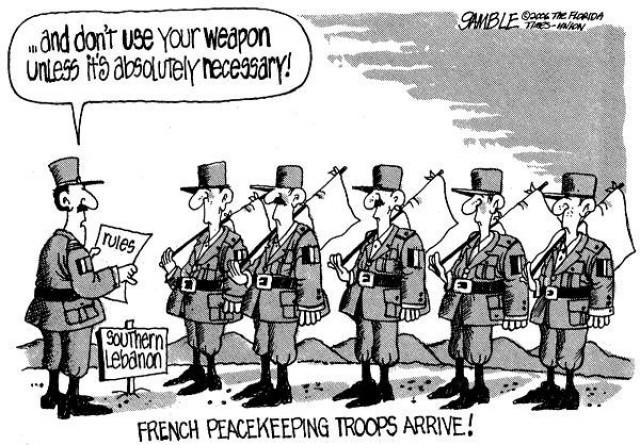
Thanks to CornetJim for this one...T 
Click here for full article
Wednesday, October 04, 2006
Patterns Emerge: A Wellstone Moment?
Here's a piece that I think gets it right (from H.H.). This IM-sex think is big in the media, and has given a little boost to the generic poll #'s, but we still are only looking at a 10 seat loss, max, and it's still a month to election day (15 is the magic number). This is before the backlash begins, and it will! (read on), before the war returns to issue #1, and before the ad campaign hits the Dem's with their votes against Intelligence eavesdropping, against funding for the war, against entitlement reform, in favor of tax increases and impeachment etc....I still predict a maximum 8-10 seat loss in the house and 2-4 seats in the Senate, with the possibility of only 1-2 and 5-6 in the house...T
Reading the comment boards here, it seems some people (especially liberal people) have either short or selective memories when it comes to Paul Wellstone’s funeral. Here’s what happened: A man who was liked and respected by all, including his ideological opponents, died tragically in a plane crash. At his memorial service, Democratic partisans opted to use his metaphorical coffin as a campaign prop while trying to rally the faithful.
If that was all that happened that night, it would have been plenty distasteful. But what made the Wellstone Memorial noteworthy was its raw ugliness. Republican dignitaries who attended the event to show their respect for Wellstone were booed when their images were shown on the Jumbotron. Many fevered-swamp type Democrats saw nothing wrong with this. The country recoiled from the spectacle, utterly repulsed and shocked. To many Democrats, though, the unsightliness of the Wellstone funeral apparently remains an obscure mystery.
The Democratic Party seems intent on replaying this mistake with the Foley affair. Let’s temporarily put aside the timing of the release of the Instant Messages and who-knew-what-when. Let’s just say for the moment that while the media currently hounds the Republican leadership, it’s a safe bet that it wasn’t the Republican leadership that plopped Foley’s IM’s into the lap of ABC News. If whoever was the errand boy delayed delivery to best achieve maximum political benefit, then the Democrats’ newfound status as the party of conventional morality will receive a decided blow.
But the real story here is the party’s eagerness to use victimized children as a campaign prop. The Patty Wettering campaign spot that I linked to earlier today tips the Democrats’ hand. Wettering is best known as a children’s advocate. Her own 16 year old was kidnapped and never found. Thus, Wettering has the proverbial Cindy Sheehan cloak of putative “absolute moral authority” that the simple-minded so admire.
It seems a tad too convenient that Wettering’s campaign is not only serving as the tip of the spear for the Democrats’ Foley offensive, but that the campaign’s ad has grossly distorted the facts of the Foley scandal. Her ad maintains that Foley molested children. One can almost picture Wettering asserting that her absolute moral authority gives her the right to redefine molestation to include things that happen in a virtual realm, and defying anyone to fight her on that ground. And once Wettering defines what happened as “molestation,” the rest of the party will surely follow.
The Wettering campaign’s advertisement also says that congressional leaders “have admitted” to covering up Foley’s antics. There again, Wettering advances the Foley narrative into completely unsupported realms.
WHAT’S UNSEEMLY HERE harkens back to the Wellstone funeral. Although Democrats didn’t realize it at the time and most of them still don’t realize it today, their real sin that night was using a friend’s coffin as a political bludgeon. The old saying is that in America, politics ends at the water’s edge. That saying reflects the fact that most Americans strongly feel that politics belongs in a distinct realm. When a party invites politics to a funeral, it offends the sensibilities of most Americans. It also shows the party doing the inviting to be craven to its core.
The Democrats are now doing the same thing. On the one hand you’ve got Patti Wetterling suggesting that Foley’s crimes were so grave that they should be labeled molestation. On the other hand, you’ve got Wetterling trying to use the victims of those crimes for electoral advantage. As John F. Kennedy once said about Richard Nixon, “No class.”
And speaking of Kennedys, I write this piece about five miles away from Ted Kennedy’s Back Bay mansion. The Senator is probably sleeping in this morning since the Senate’s not in session and he’s running for re-election this Fall essentially unopposed.
But Ted Kennedy remains a living, breathing reminder of why the Democrats’ urgent conversion to the party of traditional values is risibly misguided. So, too, does Patty Wetterling’s latest campaign stumble.
Click here for full article
Who's Really in Denial?
It's not President Bush.
A brief article, but needed now, in the face of the usual pre-election-Dan-Rather-MSM-phony-cooked-up scandal to help the Dem's (Foley, NIE leak, etc)...Anyway; the real issue deciding this election will be the war (as it should be)...T
"Americans face the choice between two parties with two different attitudes on this war on terror." --George W. Bush, September 28, 2006
President Bush is right. It would be nice if he weren't. The country would be better off if there were bipartisan agreement on what is at stake in the struggle against jihadist Islam. But despite areas of consensus, there is still a fundamental difference between the parties. Bush and the Republicans know we are in a serious war. It's not the Bush administration that is in a "State of Denial" (as the new Bob Woodward book has it). It's the Democrats.
Consider developments over the last week. Democrats hyped last Sunday's news stories breathlessly reporting on one judgment from April's National Intelligence Estimate (NIE)--that the war in Iraq has created more terrorists. More than would otherwise have been created if Saddam were still in power? Who knows? The NIE seems not even to have contemplated how many terrorists might have been created by our backing down, by Saddam's remaining in power to sponsor and inspire terror, and the like. (To read the sections of the NIE subsequently released is to despair about the quality of our intelligence agencies. But that's another story.) In any case, the NIE also made the obvious points that, going forward, "perceived jihadist success [in Iraq] would inspire more fighters to continue the struggle elsewhere," while jihadist failure in Iraq would inspire "fewer fighters . . . to carry on the fight."
What is the Democratic response to these latter judgments? Silence. The left wing of the party continues to insist on withdrawal now. The center of the party wants withdrawal on a vaguer timetable.
Bush, on other hand, understands that the only acceptable exit strategy is victory. (If, as Woodward reports, he's been bolstered in that view by Henry Kissinger, then good for Henry. Invite him to the Oval Office more often!) To that end, Bush should do more. He should send substantially more troops and insist on a change of strategy to allow a real counterinsurgency and prevent civil war. But at least he's staying and fighting. And the great majority of Republicans are standing with him. The Democrats, as Bush has put it, "offer nothing but criticism and obstruction, and endless second-guessing. The party of FDR and the party of Harry Truman has become the party of cut-and-run."
So there really is a profound difference between the parties, as Democrats are happy to acknowledge, since they think Iraq is a winning issue for them. The Democratic talking point is this: We're against Bush on Iraq, but we are as resolute as Bush in the real war on terror (understood by them to exclude Iraq). Except that they're not.
That's why last week's votes in Congress on the detainees legislation were so significant. The legislation had nothing to do with Iraq. It was a "pure" war-on-terror vote. And the parties split. Three-quarters of the Democrats in the House and Senate stood with the New York Times and the American Civil Liberties Union for more rights for al Qaeda detainees, and against legislation supported by the Bush administration (as well as by John McCain and Joe Lieberman). Some Democrats in competitive races--such as Rep. Harold Ford, running for the Senate in Tennessee--supported the legislation. But it remains the case that a vote for Democrats is a vote for congressional leaders committed to kinder and gentler treatment of terrorists.
No wonder voters think the country will be safer from terrorism if the GOP retains control of Congress. And no wonder that focus groups--according to the Democratic polling firm of Greenberg Quinlan Rosner--show that "attacks on Democrats for opposing any effort to stop terrorists . . . were highly effective." The Democratic pollsters recommended countering the attacks forcefully. But how? There are votes, in black and white in the Congressional Record, ready to be used in campaign ads.
The most important front in the confrontation with terror-sponsoring, WMD-seeking Islamic jihadism in the next two years may well be Iran. Republicans are viewed by a 12-point margin as the party that would be more likely to prevent Iran from acquiring nuclear weapons. We have been critical of the Bush administration's lassitude in attending to this task. But with sand in the diplomatic hourglass running out, voters can fairly be asked: Would Bush have more help in denying Ahmadinejad nuclear weapons from a Congress controlled by Republicans or by Democrats (whose main suggestion has been to cozy up to Iran without insisting that it verifiably suspend its nuclear program)?
Off-year elections--especially when one party controls the presidency and Congress--are almost always dominated by the expression of grievances with that party's performance. The Bush administration and the congressional leadership have given cause for grievance. But the choice is so stark this November that grievances should be put aside--if Republicans have the nerve to continue to clarify the choice over the next month. Last week was a good start.
Click here for full article
Sunday, October 01, 2006
Campaign 2006: The Republicans' Secret Weapon
You think the GOP is sure to lose big in November? They aren't. Here's why things don't look so bad to them
Even Time magazine (super dribbling liberal) is waking up and smelling the coffee...T
The polls keep suggesting that Republicans could be in for a historic drubbing. And their usual advantage—competence on national security—is constantly being challenged by new revelations about bungling in Iraq. But top Republican officials maintain an eerie, Zen-like calm. They insist that the prospects for their congressional candidates in November's midterms have never been as bad as advertised and are getting better by the day. Those are party operatives and political savants whose job it is to anticipate trouble. But much of the time they seem so placid, you wonder whether they know something.
They do. What they know is that just six days after George W. Bush won re-election in 2004, his political machine launched a sophisticated, expensive and largely unnoticed campaign aimed at maintaining G.O.P. majorities in the House and Senate. If that campaign succeeds, it would defy history and political gravity, both of which ordain that midterm elections are bad news for a lame-duck President's party, especially when the lame duck has low approval ratings. As always, a key part of the campaign involves money—the national Republican Party is dumping at least three times as much into key states as its Democratic counterpart is—but money is only the start. "Panic results when you're surprised," says Republican National Committee (r.n.c.) chairman Ken Mehlman. "We've been preparing for the toughest election in at least a decade."
Thanks to aggressive redistricting in the 1990s and early 2000s, fewer than three dozen House seats are seriously in contention this election cycle, compared with more than 100 in 1994, the year Republicans swept to power with a 54-seat pickup in the House. Then there's what political pros call the ground game. For most of the 20th century, turning out voters on Election Day was the Democrats' strength. They had labor unions to supply workers for campaigns, make sure their voters had time off from their jobs to go to the polls and provide rides to get them there.
Now, though, Democrats are the ones playing catch-up when it comes to the mechanics of Election Day. Every Monday, uberstrategist Karl Rove and Republican Party officials on Capitol Hill get spreadsheets tallying the numbers of voters registered, volunteers recruited, doors knocked on and phone numbers dialed for 40 House campaigns and a dozen Senate races. Over the next few weeks, the party will begin flying experienced paid and volunteer workers into states for the final push. The Senate Republicans' campaign committee calls its agents special teams, led by marshals, all in the service of the partywide effort known as the 72-Hour Task Force because its working philosophy initially focused on the final three days before an election.
So Republicans hope to close the deal in tight races with a get-out-the-vote strategy that was developed in the wreckage of the 2000 presidential campaign. Bush's team was led then, as it is now, by Rove, Bush's political architect and now White House deputy chief of staff, and Mehlman, then White House political-affairs director. Their theory was that Bush lost 3% or 4% of his expected vote in 2000 because those people just stayed home.
What Rove and Mehlman wanted to figure out was the code for increasing the number of Republican voters who could be reliably summoned to the polls—a code that, once cracked, could be used to win election after election. "We want to turn 75%-Republican areas into 78%- or 79%-Republican areas while at the same time turning 15% areas into 18% or 19% areas," says Mike DuHaime, political director of the R.N.C. In the off year of 2001, the creators of the 72-Hour program tested it in odd, lower-profile contests, including court races in Pennsylvania. The Bushies picked clusters of precincts where they quietly tried their new methods, then compared those with similar precincts where the campaigns did things the more traditional way. Those experiments helped Republicans develop a handful of precepts that constitute the party's playbook for this fall:
1. Learn from the past Fifteen G.O.P. data experts spent months after the '04 election comparing turnout records from the swing states with the Bush-Cheney campaign's databases to figure out the optimal amount of mail, phone calls and door knocks that would persuade a probable G.O.P. voter to go to the polls.
2. Draw in new voters The Bush-Cheney campaign used state records to locate potential Republicans with Florida State University license plates, then had fellow Seminoles call them to sound out their views. Whereas parties used to go after certain precincts or zip codes, Republicans now know even which individual households they want through microtargeting—the use of computerized consumer data, from magazine subscriptions to charitable contributions, to help locate voters who are likely to vote Republican if they turn out. Other telltale signs of potential latent Republicanism are snowmobile ownership and enrollment in private schools.
3. Low tech can be better Caller ID, TiVo, cable channels and satellite radio all make it harder to reach voters than it was just a few years ago, increasing the importance of person-to-person appeals, the hallmark of old-fashioned, grassroots campaigns that used to connote an amateur or a low budget. "You clearly have to have TV ads," says White House political-affairs director Sara Taylor, "but for a little less TV, you can buy a whole lot of pizzas and phone lines and salaries for young men and women right out of college" to make phone calls, knock on doors and recruit and manage volunteers.
4. Details, details The shopping list includes everything from chairs to cell phones for hundreds of workers for Republican Party victory committees, whose staffs are charged with creating state turnout machines. TheG.O.P. says their volunteer forces in '04 proved to be more effective than the paid workers contracted by Democrats, unions and Democrat- oriented fund-raising groups. Even Election Day comes sooner for Republicans, who have begun putting a huge effort into locking down absentee voters and vote-by-mail ballots in states that use them.
5. Spend more Republican officials estimate that at the end of August, their committees and campaigns had $235 million to spend in the two-month home stretch, a $58 million advantage over Democrats. The R.N.C. plans to lay out more than $60 million on turnout efforts and advertising vs. the more than $14 million set aside by Democratic National Committee (D.N.C.) chairman Howard Dean. Senator Hillary Clinton of New York, who has been critical of Dean's approach, complained at a D.N.C. fund-raising luncheon in Washington last week that theG.O.P. "is pouring tens of millions of dollars into races, and we're not matching that." House Republican officials contend that many of their Democratic challengers are so little known that they could be buried in an ad blitz. "You hit them, and they fold like a house of cards," a strategist said.
Republicans had begun to feel better about the election recently after Bush got a bump in the polls, reflecting a steady decline in gas prices and a successful effort by the White House to push national-security issues to the top of the news. But by last week G.O.P. operatives were less elated. Newscasts were trumpeting the tales of infighting in Bush's war cabinet told in Bob Woodward's State of Denial, a book full of stories about an Administration pursuing a war with no clue how to go about it. And Representative Mark Foley, a Republican from Florida, resigned after his X-rated Internet chats with teenage boys from the House page program were made public. A safe seat for Republicans was suddenly in jeopardy.
Republicans acknowledge one ominous vulnerability: for more than a decade, the party has benefited from an intensity gap. Stoked by hatred of Bill Clinton or love for George W. Bush, G.O.P. voters have been more certain to vote than Democrats—meaning that the party tends to perform better than the final opinion polls suggest. Representative Rahm Emanuel of Illinois, head of the House Democrats' campaign committee, recently told Time that gap had counted for as much as 5 to 7 points for the Republicans. But he thinks this election year might be different. "Their voters are unhappy," he says. "They're despondent about a failed President."
White House officials also concede they aren't so sure that Republicans will be motivated to go to the polls this year. Of course, expressions of doubt on the part of senior Republicans could be part of another game the G.O.P. plays better than the Democrats do these days: the expectations game. The Republicans are, after all, in the enviable position of being able to lose a lot. As long as they end up keeping control of both houses, they still come out the winner on Election Day.
Click here for full article
Saturday, September 30, 2006
Islamic Fascism 101: On all they’ve done to earn the name
"Fascist" ...The word sounds simplistic, even now, 60 years after WWII. We have basked in victory since the cold war days, and antiquated ideologies like Fascism sound simplistic. The problem with this thinking is that the Arabs have BEEN fascists for almost 100 years, since the turn of the 19th century. We have no choice, now, but total victory...T
Make no apologies for the use of “Islamic fascism.” It is the perfect nomenclature for the agenda of radical Islam, for a variety of historical and scholarly reasons. That such usage also causes extreme embarrassment to both the Islamists themselves and their leftist “anti-fascist” appeasers in the West is just too bad.
First, the general idea of “fascism” — the creation of a centralized authoritarian state to enforce blanket obedience to a reactionary, all-encompassing ideology — fits well the aims of contemporary Islamism that openly demands implementation of sharia law and the return to a Pan-Islamic and theocratic caliphate.
In addition, Islamists, as is true of all fascists, privilege their own particular creed of true believers by harkening back to a lost, pristine past, in which the devout were once uncorrupted by modernism.
True, bin Laden’s mythical Volk doesn’t bath in the clear icy waters of the Rhine untouched by the filth of the Tiber; but rather they ride horses and slice the wind with their scimitars in service of a soon to be reborn majestic world of caliphs and mullahs. Osama bin Laden sashaying in his flowing robes is not all that different from the obese Herman Goering in reindeer horns plodding around his Karinhall castle with suspenders and alpine shorts.
Because fascism is born out of insecurity and the sense of failure, hatred for Jews is de rigueur. To read al Qaeda’s texts is to reenter the world of Mein Kampf (naturally now known as jihadi in the Arab world). The crackpot minister of its ideology, Dr. Zawahiri, is simply a Dr. Alfred Rosenberg come alive — a similar quarter-educated buffoon, who has just enough of a vocabulary to dress up fascist venom in a potpourri of historical misreadings and pseudo-learning.
Envy and false grievance, as in the past with Italian, German, or Japanese whining, are always imprinted deeply within the fascist mind. After all, it can never quite figure out why the morally pure, the politically zealous, the ever more obedient are losing out to corrupt and decadent democracies — where “mixing,” either in the racial or religious sense, should instead have enervated the people.
The “will” of the German people, like the “Banzai” spirit of the Japanese, should always trump the cowardly and debased material superiority of decadent Western democracies. So al Qaeda boasts that in Somalia and Afghanistan the unshakeable creed of Islam overcame the richer and better equipped Americans and Russians. To read bin Laden’s communiqués is to be reminded of old Admiral Yamamato assuring his creepy peers that his years in the United States in the 1920s taught him that Roaring Twenties America, despite its fancy cars and skyscrapers, simply could not match the courage of the chosen Japanese.
Second, fascism thrives best in a once proud, recently humbled, but now ascendant, people. They are ripe to be deluded into thinking contemporary setbacks were caused by others and are soon to be erased through ever more zealotry. What Versailles and reparations were to Hitler’s new Germany, what Western colonialism and patronizing in the Pacific were to the rising sun of the Japanese, what the embarrassing image of the perennial sick man of Europe was to Mussolini’s new Rome, so too Israel, modernism, and America’s ubiquitous pop culture are to the Islamists, confident of a renaissance via vast petro-weatlh.
Such reactionary fascism is complex because it marries the present’s unhappiness with moping about a regal past — with glimpses of an even more regal future. Fascism is not quite the narcotic of the hopeless, but rather the opiate of the recently failed now on the supposed rebound who welcome the cheap fix of blaming others and bragging about their own iron will.
Third, while there is generic fascism, its variants naturally weave preexisting threads familiar to a culture at large. Hitler’s brand cribbed together notions of German will, Aryanism, and the cult of the Ubermensch from Hegel, Nietzsche, and Spengler, with ample Nordic folk romance found from Wagner to Tacitus’s Germania. Japanese militarism’s racist creed, fanaticism, and sense of historical destiny were a motley synthesis of Bushido, Zen and Shinto Buddhism, emperor worship, and past samurai legends. Mussolini’s fasces, and the idea of an indomitable Caesarian Duce (or Roman Dux), were a pathetic attempt to resurrect imperial Rome. So too Islamic fascism draws on the Koran, the career of Saladin, and the tracts of Nasserites, Baathists, and Muslim Brotherhood pamphleteers.
Fourth, just as it was idle in the middle of World War II to speculate how many Germans, Japanese, or Italians really accepted the silly hatred of Hitler, Mussolini, or Tojo, so too it is a vain enterprise to worry over how many Muslims follow or support al Qaeda, or, in contrast, how many in the Middle East actively resist Islamists.
Most people have no ideology, but simply accommodate themselves to the prevailing sense of an agenda’s success or failure. Just as there weren’t more than a dozen vocal critics of Hitler after the Wehrmacht finished off France in six weeks in June of 1940, so too there wasn’t a Nazi to be found in June 1945 when Berlin lay in rubble.
It doesn’t matter whether Middle Easterners actually accept the tenets of bin Laden’s worldview — not if they think he is on the ascendancy, can bring them a sense of restored pride, and humiliate the Jews and the West on the cheap. Bin Laden is no more eccentric or impotent than Hitler was in the late 1920s.Yet if he can claim that his martyrs forced the United States out of Afghanistan and Iraq, toppled a petrol sheikdom or two, and acquired its wealth and influence — or if he got his hands on nuclear weapons and lorded it over appeasing Westerners — then he too, like the Fuhrer in the 1930s, will become untouchable. The same is true of Iran’s president Ahmadinejad.
Fifth, fascism springs from untruth and embraces lying. Hitler had contempt for those who believed him after Czechoslovakia. He broke every agreement from Munich to the Soviet non-aggression pact. So did the Japanese, who were sending their fleet to Pearl Harbor even as they talked of a new diplomatic breakthrough.
Al-Zawahiri in his writings spends an inordinate amount of effort excusing al Qaeda’s lies by referring to the Koranic notions of tactical dissimulation. We remember Arafat saying one thing in English and another in Arabic, and bin Laden denying responsibility for September 11 and then later boasting of it. Nothing a fascist says can be trusted, since all means are relegated to the ends of seeing their ideology reified. So too Islamic fascists, by any means necessary, will fib, and hedge for the cause of Islamism. Keep that in mind when considering Iran’s protestations about its “peaceful” nuclear aims.
We can argue whether the present-day Islamic fascists have the military means comparable to what was had in the past by Nazis, Fascists, and militarists — I think a dirty bomb is worth the entire Luftwaffe, one nuclear missile all the striking power of the Japanese imperial Navy — but there should be no argument over who they are and what they want. They are fascists of an Islamic sort, pure and simple.And the least we can do is to call them that: after all, they earned it.
Click here for full article
Thursday, September 28, 2006
Big Mo in GOP's corner
Here's more of the midterm election predictions I have been following Once again, it seems that the Drive-by-media have shamelessly hyped the Dem's chances this November. We will hold the house. In the Senate, things are dicey, but we will hold there as well, mainly because of New Jersey and Maryland among other quite possible gains. I think we lose Ohio and Pennsylvania and one or two others, coming in around a 3 seat overall loss. In the house, perhaps 5 seats lost tops. Still good enough to win the war and confirm the judges (as H.H would put it!)...T
WASHINGTON -- Even the most partisan Democrats have said all year they expected their 6- to 10-point advantage over the Republicans in the party-preference polls to tighten as Election Day neared.
But certainly no one expected the midterm congressional elections to tighten as much as they have so early in the general election cycle.
Earlier this month, the Gallup Poll reported a 4- to 6-point advantage for the Democrats, which fell to 2 to 3 points, and is now down to a "dead heat" among likely voters who say they will vote Republican (48 percent) and those who say they will vote Democratic (48 percent).
This is not to say the GOP will dodge the bullet and still hang on to majority control of the House. Democrats have maintained an advantage all year among registered voters and still do. But historically, the turnout record among registered voters has lagged behind likely voters, a group that pollsters consider to be a much more accurate measurement of the electorate's preferences.
Midterm elections tend to draw a smaller voter turnout than presidential elections, and Gallup pointed out, in an analysis of their latest findings, that if the race is a dead heat nationally among likely voters, Republicans have the potential to offset the Democrats' lead among registered voters "with greater turnout" from their base. That's because the Republicans are better at the voter-turnout game than the Democrats -- a talent they demonstrated in 2000, 2002 and 2004.
But for the first time this year, Gallup not only said the battle for control of Congress is a dead heat, it said that if the GOP's much-improved numbers "persist until Election Day, it suggests Republicans would be able to maintain their majority-party status in the House."
All of this is the result of some amazing campaigning by President Bush (that has lifted his anemic job-approval scores to 44 percent) and several weeks of speeches refocusing the nation on the war on terrorism and connecting it to the war in Iraq. Polls show his strategy has been a key factor in moving the numbers in the GOP's direction.
Democratic strategists such as Simon Rosenberg, president of the New Democrat Network, conceded that Bush's efforts to elevate the terrorism issue in the campaign "has been marginally effective. The Republicans got a bounce out of the 9/11 speech. The president does have the ability to change the debate in the country. The problem is, it is not sustainable."
In fact, additional polling data released by Gallup within the past week or two suggested that not only is the president changing the voters' attitudes on the Iraq war but the Democrats' failure to shape a clear, convincing message about dealing with terrorism and Iraq has hurt them.
Here's what the nonpartisan Gallup Poll has to say about all this in a separate analysis of its numbers:
"Americans are more positive about the war on terror, and voters are more likely to vote for a candidate who supports Bush on terrorism rather than one who opposes him. By a slight margin, Americans tend to think that the country will be safer from terrorism if the GOP retains control of the House, rather than if the Democrats take control.
"And voters are now as likely to say that the war in Iraq is part of the war on terror as say it is not," Gallup said.
Missing from all the yearlong political analysis we've heard about the GOP's troubles is the unspoken realization that the Democrats are in deep trouble, too. To be sure, a majority of Americans still disapprove of Bush's handing of the war in Iraq, but only one in four now "believes the Democrats have a clear plan on Iraq -- fewer than those who say this about the Bush administration," Gallup said.
"Also, Americans are about equally likely to say they would vote for a candidate who supports President Bush on Iraq as to vote for a candidate who opposes Bush," the analysis said.
What should worry Democratic campaign officials "is the fact that only 14 percent say the Democrats have a clear plan but Bush does not, while a greater percentage (23 percent) says Bush has a clear plan but the Democrats do not," Gallup said.
This is all pretty strong stuff from the premier polling organization in the country, known for its caution and evenhanded approach to the vicissitudes of voting trends in the elections.
But a survey of the past week's polls and what is happening in many of the races appeared to confirm Gallup's findings.
The Los Angeles Times, which polled 1,347 registered voters, last week reported, "On virtually every comparison between the parties measured in the survey, Republicans have improved their position since early summer.
"In particular, Republicans have nearly doubled their advantage when voters are asked which party they trust most to protect the nation against terrorism," the newspaper said.
Of course, this election will not be decided by a national vote but by who wins in some 30 competitive congressional districts and a half-dozen Senate races. There's no doubt the Democrats will gain seats on Nov. 7, but Gallup's numbers suggest the Republicans clearly have the momentum right now.
Click here for full article
Monday, September 18, 2006
Building Red America
This piece is a companion to the previous post. Not only have the Republicans caught up to the Dems in the midterm election polls, negating the possibility of a takeover of either house, but their leaders cynically realize it, and attribute it to factors that...well, read on, you won't be disappointed!...T
WASHINGTON -- In this autumn of their discontent, Republicans tremble as November nears. But now comes yet another book by a gloomy liberal anticipating permanent Republican dominance. Thomas B. Edsall of The New Republic, in ``Building Red America: The New Conservative Coalition and the Drive for Permanent Power,'' argues that inexorable social forces, augmented by the conservatives' superior reservoirs of anger, ruthlessness and cynicism -- he neglects only the word ``wickedness'' -- favor Republicans, ``the party of the socially and economically dominant.''
The parties are almost at numerical parity, but Edsall, who until recently was a Washington Post political reporter, says Republicans represent people ``more broadly skilled in economic combat'' and ``more accustomed to the rigors of the market.'' Hence Republicans can maintain ``a thin but durable margin of victory.'' Their technique is ``the symbolic manipulation of controversial sociocultural issues touching upon national security, patriotism, race, sex, and religion.''
``The GOP,'' Edsall laments, ``has achieved a gradual erosion of the popular consensus behind the major progressive and social-egalitarian movements of the twentieth century.'' But what actually ``achieved'' that? Edsall says the principal Republican objective has been to break ``the trust ... between the government and millions of its less advantaged citizens.'' But he acknowledges that Republicans have been helped ``inestimably'' by ``the daily inefficiencies of government'': ``The monopoly nature of government guarantees that the public services will often lag in quality behind those delivered in the competitive private sector.'' Hence ``the declining credibility of non-market solutions to economic problems'' and the demoralization of ``backers of a redistributive agenda.''
Edsall complains that conservatives pursue an agenda that does not have the public's ``decisive support.'' Whatever that means, liberals like Edsall are ineligible to make that complaint. They increasingly have abandoned persuasion and legislation and resorted to litigation and judicial fiats to advance an agenda the public finds unpersuasive.
If Edsall is symptomatic, liberalism is lost in a time warp, thinking in antiquated categories. Edsall approvingly quotes a Democratic activist's opinion that there are twice as many angry conservatives as there are angry liberals: ``Liberals by their very nature don't get as angry as conservatives do.'' Edsall, who evidently has not noticed the vitriol of the liberal blogosphere, is so blinded by his own anger he misperceives Republican realities.
The GOP, he says, courts whites ``whose interests are overwhelmingly focused on tempering, if not altogether rolling back, the civil rights movement.'' Please. Who favors rolling back guarantees of voting rights and equal access to public accommodations?
If Edsall really thinks Republicans are marching efficiently in lock step, he has missed bitter intraparty arguments about spending, immigration and nation-building. Edsall says the conservative agenda is ``to dismantle the welfare state.'' Oh? With a prescription drug entitlement that is the largest expansion of the welfare state since enactment of Medicare in 1965? With a 38 percent increase in discretionary domestic spending unrelated to homeland security -- including a 135 percent increase in the Education Department's budget -- since 2001?
When Edsall says middle- and working-class cultural conservatives vote for Republicans who then use their power ``for noncultural objectives,'' he is voicing a familiar liberal lament: All would be well if voters would vote based on important issues -- material, economic concerns; their wallets -- rather than unimportant ones such as abortion, the definition of marriage, the coarsening of the culture and other moral anxieties. But if those issues are unimportant, why is it that liberals, adamantly supporting partial-birth abortion and celebrating judicial redefinitions of marriage, are so uncompromising about them? As Edsall says, liberalism has become bifurcated. The largest faction looks to government for material help. But the socially liberal ``post-materialist'' cadre ``overwhelmingly sets'' the party's agenda.
Edsall notes that one-third of American children -- and almost 70 percent of African-American children -- are born to unmarried mothers. Then, in an astonishing passage about this phenomenon, which is the cause of most social pathologies, from crime to schools that cannot teach, he explains how Americans differ concerning what he calls ``freedom from the need to maintain the marital or procreative bond.''
``To social conservatives,'' he writes, ``these developments have signaled an irretrievable and tragic loss. Their reaction has fueled, on the right, a powerful traditionalist movement and a groundswell of support for the Republican Party. To modernists, these developments constitute, at worst, the unfortunate costs of progress, and, at best -- and this is very much the view on the political left as well as of Democratic Party loyalists -- they constitute a triumph over unconscionable obstacles to the liberation and self-realization of much of the human race.''
Looking for the real reason for the rise of ``Red America''? Read that paragraph again.
Click here for full article
Republicans gain in midterm polls
As I have been predicting, the polls have lately swung dramatically in the favor of the Republicans and the administration's policies. The Tsunami predicted for the fall now looks to be no more than a few whitecaps, even to to the point of possible R-GAINS in the Senate or House. The 1st of two articles, here...T
Republicans appear to be gaining on the Democrats in the 2006 midterm campaign because of growing confidence in the economy, falling gas prices and President Bush's sustained political offensive on the terrorist threat, according to pollsters and campaign strategists.
The most significant political movement in the past week or two has been in the battle for control of Congress. National preference polls on the so-called "generic ballot" question -- which party's candidate voters say they would choose -- show Republicans have narrowed the once-substantial lead Democrats held and are now trailing them by three percentage points, independent pollster John Zogby said Friday.
Mr. Zogby credited the Republican Party's sudden political turnaround to "the president's focus on the war on terrorism, a rebound among his own base," and the Democrats' failure to lay out a clear plan of their own on "how are we're going to get out of Iraq and what they would do about terrorism that's better than the Republicans."
Democrats "are not giving their Democratic base what it needs to hear on those issues," Mr. Zogby said. "Republicans are severely wounded. The Democrats should be crushing them, and they are not."
Top election forecasters have pointed to an anti-Bush and anti-Republican "wave" that they predict will return the Democrats to majority power in the House, but Mr. Zogby said, "I don't see the landslide that others are seeing. That doesn't mean it can't materialize, but as of today, it's not happening and this is mid-September."
Some pollsters, such as Gallup, still show the Democrats enjoying larger, 12-point leads in the generic surveys. But Mr. Zogby's numbers mirror a tightening in several other voter-preference polls, including a Fox News poll of likely voters, and what campaign strategists and political reporters say they are seeing in the battleground states.
The Republican Party's improving polls coincide with a number of positive developments on the economic front that Republicans hope will further lift their political prospects in November. The price of oil dropped to nearly $62 a barrel Friday from a high of $77 last month, as gasoline prices continued their descent to a national average of $2.62 per gallon, though many battleground states were reporting lower prices for regular.
Some of the lowest averages included Iowa, $2.32; Indiana, $2.36; Missouri and Ohio, $2.25; Minnesota, $2.35; Michigan $2.37; and Kentucky, $2.34.
As gas prices fell, the stock market was rising, with the Dow Jones industrial average soaring to 11,560 Friday, 162 points from its all-time high, that boosted worker pensions -- and a consumer confidence survey showed Americans were "in a decidedly more optimistic mood," the Ipsos poll reported Friday.
The Republicans' improving poll numbers were also reflected in a number of tighter House and Senate races, while a separate Zogby poll showed that Republicans in three high-profile Senate races -- in New Jersey, Pennsylvania and Ohio -- had improved their poll numbers significantly in just the past week or two.
Much of the party's gain was the result of Republicans coming home to their party as Mr. Bush focused on the issues that most deeply divide the country -- Iraq and the war on terrorism.
"The base is finally coming around. Democratic intensity has been strong for the last year, but Republican intensity all of a sudden has increased," said Republican campaign strategist John Brabender, who is advising Sen. Rick Santorum of Pennsylvania in his re-election campaign.
"Some of the positive things that are happening in the economy are starting to cause some excitement among Republicans," Mr. Brabender said.
"We're seeing a tightening up in the congressional races, too, in the last 10 days. The president is putting out a much more targeted message, talking about the security of the country. For the first time, he's playing more offense than defense and that's helping Republicans," he said.
Click here for full article
Thursday, September 14, 2006
Analysts predict gas at $1.15 a Gallon
Time for a mirror check, all my wacko conspiracy-thoeorist friends. The price of oil is determined by global market forces, and always has been, at least since deregulaation in 1981 (hmm, who was Prez in those days?...)...T
WASHINGTON — The recent sharp drop in the global price of crude oil could mark the start of a massive sell-off that returns gasoline prices to lows not seen since the late 1990s — perhaps as low as $1.15 a gallon.
"All the hurricane flags are flying" in oil markets, said Philip Verleger, a noted energy consultant who was a lone voice several years ago in warning that oil prices would soar. Now, he says, they appear to be poised for a dramatic plunge.
Crude-oil prices have fallen about $14, or roughly 17 percent, from their July 14 peak of $78.40. After falling seven straight days, they rose slightly Wednesday in trading on the New York Mercantile Exchange, to $63.97, partly in reaction to a government report showing fuel inventories a bit lower than expected. But the overall price drop is expected to continue, and prices could fall much more in the weeks and months ahead.
Here's why:
For most of the past two years, oil prices have risen because the world's oil producers have struggled to keep pace with growing demand, particularly from China and India. Spare oil-production capacity grew so tight that market players feared that any disruption to oil production could create shortages.
Fear of disruption focused on fighting in Nigeria, escalating tensions over Iran's nuclear program, violence between Israel and Lebanon that might spread to oil-producing neighbors, and the prospect that hurricanes might topple oil facilities in the Gulf of Mexico.
Oil traders bet that such worrisome developments would drive up the future price of oil. Oil is traded in contracts for future delivery, and companies that take physical delivery of oil are just a small part of total trading. Large pension and commodities funds are the big traders and they're seeking profits. They've sunk $105 billion or more into oil futures in recent years, according to Verleger. Their bets that oil prices would rise in the future bid up the price of oil.
That, in turn, led users of oil to create stockpiles as cushions against supply disruptions and even higher future prices. Now inventories of oil are approaching 1990 levels.
But many of the conditions that drove investors to bid up oil prices are ebbing. Tensions over Israel, Lebanon and Nigeria are easing. The hurricane season has presented no threat so far to the Gulf of Mexico. The U.S. peak summer driving season is over, so gasoline demand is falling.
With fear of supply disruptions ebbing, oil prices began sliding. With oil inventories high, refiners that turn oil into gasoline are expected to cut production. As refiners cut production, oil companies increasingly risk getting stuck with excess oil supplies. There's already anecdotal evidence of oil companies chartering tankers to store excess oil.
All this is turning financial markets increasingly bearish on oil.
"If we continue to build inventories, and if we have a warm winter like we had last winter, you could see a large fall in the price of oil," said Gary Pokoik, who manages Hedge Ventures Energy in Los Angeles, an energy hedge fund. "I think there is still a lot of risk in the market."
As it stands now, the recent oil-price slump has brought the national average for a gallon of unleaded gasoline down to $2.59, according to the AAA motor club. In the Seattle area, prices per gallon have fallen to $2.856 currently from $3.071 a month ago, a decline of 7 percent, according to AAA.
Should oil traders fear that this downward price spiral will get worse and run for the exits by selling off their futures contracts, Verleger said, it's not unthinkable that oil prices could return to $15 or less a barrel, at least temporarily. That could mean gasoline prices as low as $1.15 per gallon.
Other experts won't guess at a floor price, but they agree that a race to the bottom could break out.
"The market may test levels here that are too low to be sustained," said Clay Seigle, an analyst at Cambridge Energy Research Associates, a consultancy in Boston.
On Monday, the oil-producing cartel OPEC hinted that if prices fall precipitously, OPEC members would cut production to lift them. But that would take time.
"That takes six to nine months. If we don't have a really cold winter here [creating a demand for oil], prices will fall. Literally, you don't know where the floor is," Verleger said. "In a market like this, if things start falling ... prices could take you back to the 1999 levels. It has nothing to do with production."
Click here for full article
Monday, September 04, 2006
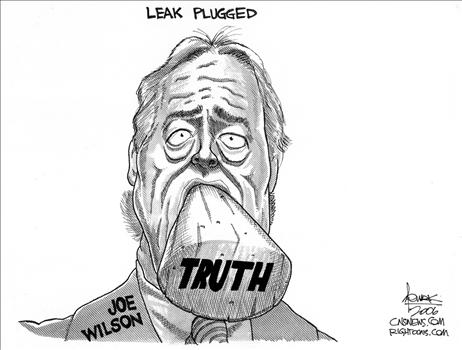
Why abduct us? We cede our values for free
Steyn gets it exactly right, here. Any sign of weakness is interpreted as an Gold-embossed invitation to attack us. They view us as corrupt, lazy, fat hedonists who will ransom all, for a moment of luxury. After viewing "The path to 9/11" on the 10th and 11th on ABC, rent "United Flight 93" . If these don't convince you, chances are you are beyond reach. We must be bold and audacious in our mission, more so than the modern world's sensibilities can palate, I fear...T
Did you see that video of the two Fox journalists announcing they'd converted to Islam? The larger problem, it seems to me, is that much of the rest of the Western media have also converted to Islam, and there seems to be no way to get them to convert back to journalism.
Consider, for example, the bizarre behavior of Reuters, the once globally respected news agency now reduced to putting out laughably inept terrorist propaganda. A few days ago, it made a big hoo-ha about the Israelis intentionally firing a missile at its press vehicle and wounding its cameraman Fadel Shana. Shana was posed in an artful sprawl in a blood-spattered shirt. But it had ridden up and underneath his undershirt was spotlessly white, like a summer-stock Julius Caesar revealing the boxers under his toga. What's stunning is not that almost all Western media organizations reporting from the Middle East are reliant on local staff overwhelmingly sympathetic to one side in the conflict -- that's been known for some time -- but the amateurish level of fakery that head office is willing to go along with.
Down at the other end of the news business, meanwhile, one finds items like this snippet from the Sydney Morning Herald:
"A 16-year-old girl was tailed by a car full of men before being dragged inside and assaulted in Sydney's west last night, police say . . .
"The three men involved in the attack were described to police as having dark 'mullet-style' haircuts."
Three men with "mullet-style" hair, huh? Not much to go on there. Bit of a head scratcher. But, as it turned out, the indefatigable Sydney Morning Herald typist had faithfully copied out every salient detail of the police report except one. Here's the statement the coppers themselves issued:
"Police are seeking three men described as being of Middle Eastern/Mediterranean appearance, with dark 'mullet-style' hair cuts."
That additional detail narrows it down a bit, wouldn't you say? The only reason I know that is because the Aussie Internet maestro Tim Blair grew curious about the epidemic of incidents committed by men of no known appearance and decided to look into it. One can understand the agonies the politically correct multicultural journalist must go through, distressed at the thought that an infelicitous phrasing might perpetuate unfortunate stereotypes of young Muslim males. But, even so, it's quite a leap to omit the most pertinent fact and leave the impression the Sydney constabulary are combing the city for mullets. The Boston Globe's Jeff Jacoby wrote the other day about how American children's books are "sacrificing truth on the altar of political correctness." But there seems to be quite a lot of that in the grown-up comics, too. And, as I've said before, it's never a good idea to put reality up for grabs. There may come a time when you need it.
It's striking how, for all this alleged multiculti sensitivity, we're mostly entirely insensitive to other cultures: We find it all but impossible to imagine how differently they view the world. Go back to that video in which Fox's Steve Centanni and Olaf Wiig announced their conversion to Islam. The moment the men were released, the Western media and their colleagues wrote off the scene as a stunt, a cunning ruse, of no more consequence than yelling "Behind you! He's got a gun!" and then kicking your distracted kidnapper in the teeth. Indeed, a few Web sites seemed to see the Islamic conversion routine as a useful get-out-of-jail-free card.
Don't bet on it. In my forthcoming book, I devote a few pages to a thriller I read as a boy -- an old potboiler by Sherlock Holmes' creator, Arthur Conan Doyle. In 1895 Sir Arthur had taken his sick wife to Egypt for her health, and, not wishing to waste the local color, produced a slim novel called The Tragedy of the Korosko, about a party of Anglo-American-French tourists taken hostage by the Mahdists, the jihadi of the day. Much of the story finds the characters in the same predicament as Centanni and Wiig: The kidnappers are offering them a choice between Islam or death. Conan Doyle's Britons and Americans and Europeans were men and women of the modern world even then:
"None of them, except perhaps Miss Adams and Mrs. Belmont, had any deep religious convictions. All of them were children of this world, and some of them disagreed with everything which that symbol upon the earth represented."
"That symbol" is the cross. Yet in the end, even as men with no religious convictions, they cannot bring themselves to submit to Islam, for they understand it to be not just a denial of Christ but in some sense a denial of themselves, too. So they stall and delay and bog down the imam in a lot of technical questions until eventually he wises up and they're condemned to death.
One hundred ten years later, for the Fox journalists and the Western media who reported their release, what's the big deal? Wear robes, change your name to Khaled, go on camera and drop Allah's name hither and yon: If that's your ticket out, seize it. Everyone'll know it's just a sham.
But that's not how the al-Jazeera audience sees it. If you're a Muslim, the video is anything but meaningless. Not even the dumbest jihadist believes these infidels are suddenly true believers. Rather, it confirms the central truth Osama and the mullahs have been peddling -- that the West is weak, that there's nothing -- no core, no bedrock -- nothing it's not willing to trade. In his new book The Conservative Soul, attempting to reconcile his sexual temperament and his alleged political one, Time magazine's gay Tory Andrew Sullivan enthuses, "By letting go, we become. By giving up, we gain. And we learn how to live -- now, which is the only time that matters." That's almost a literal restatement of Faust's bargain with the devil:
"When to the moment I shall say
'Linger awhile! so fair thou art!
'Then mayst thou fetter me straightway
Then to the abyss will I depart!"
In other words, if Faust becomes so enthralled by "the moment" that he wants to live in it forever, the devil will have him for all eternity. In the Muslim world, they watch the Centanni/Wiig video and see men so in love with the present, the now, that they will do or say anything to live in the moment. And they draw their own conclusions -- that these men are easier to force into the car than that 16-year-old girl in Sydney was. It doesn't matter how "understandable" Centanni and Wiig's actions are to us, what the target audience understands is quite different: that there is nothing we're willing to die for. And, to the Islamist mind, a society with nothing to die for is already dead.
Click here for full article


 Posts
Posts


