

 Stumble It!


...We can hope...T
Republicans have lost the last two presidential elections, but not much else over the past six years. They’ve captured the House and Senate. They now hold 31 governorships and 69 of the 99 state legislative chambers. What this means is pretty simple: There’s an emerging Republican majority.
The GOP still has significant emerging to do before reaching majority status. It may never get there. The rise this year may be Republicans’ peak for now. They may have achieved nothing more than what University of Virginia professor Larry Sabato calls “the emerging outline of possible GOP victory in 2016.”
At the very least, a Republican must win the White House in 2016 while maintaining control of Congress. Republicans need to attract more votes from minorities, particularly Hispanics. They must continue to improve their appeal to women. Most of all, Republicans must avoid self-inflicted wounds such as prompting another government shutdown or nominating a poor presidential candidate.
That’s a lot to pull off. But Republicans have advantages they lacked in the presidential years of 2008 and 2012. One is the eight-year itch. That’s the tendency of voters to change parties in the White House after a two-term presidency. The only exception in the last seven instances of such a presidency was the election of George H. W. Bush in 1988 after Reagan’s two terms.
And President Obama is likely to make things worse for the Democratic candidate in 2016. He is not only unpopular but also appears committed to an unpopular agenda. Every poll shows Americans want compromise in Washington. Obama’s preference is for confrontation.
Then there’s the ideological direction of the Democratic party. It’s tilting left.
All the energy and passion is on the left. The party is being McGovernized. Moderates have about as much influence as liberals do in the Republican party. The Democratic agenda—bigger government, higher taxes, increased spending, and cultural nihilism—isn’t a winning combination for 2016.
Midterm elections are not predictive of presidential outcomes. We know that from recent history: After winning in a landslide in the 2010 midterm, Republicans lost the presidential race two years later. Still, the 2014 election offers some clues about political trends. For instance, it suggests the Obama coalition is not the same as the Democratic coalition.
Obama was a great presidential candidate. He maximized the Democratic vote. But when he wasn’t on the ballot in 2010 and 2014, Democrats lost badly. Their turnout machine didn’t work as effectively without him on the ticket. So the Democratic coalition will probably be less broad in 2016.
Democrats think they have a number of current issues on their side. But issues that poll well don’t always cause voters to back candidates of the party associated with those issues. Raising the minimum wage is a good example. It’s clearly a Democratic issue. In November, voters in Arkansas, Nebraska, South Dakota, and Alaska backed increases in the minimum wage. At the same time, they elected Republicans to the Senate—and by large margins except in Alaska.
Among the major Democratic issues today are global warming, same-sex marriage, abortion, and voter ID. Global warming is so far down the list of issues that voters care about, it has dropped out of sight. The fight over gay marriage is over. Democrats benefited in two election cycles from blaming Republicans for a “war on women” involving abortion and contraception. That issue died in 2014. Opposing voter ID laws may galvanize African Americans and the party base, but that’s it. Besides, there’s no evidence such laws prevent voting.
Immigration is different. It divides the country. It’s a problem for Republicans, who need 40 percent or more of Hispanic voters to win the presidency. It is one of the few issues that actually may help Democrats. Even so, Republicans fared better with Hispanic voters in 2014 than in 2012. In Texas, Republican Greg Abbott got 44 percent of the Hispanic vote in winning the governor’s race.
The Hispanic vote is growing, but it’s voters over 65 who are increasing the fastest as a share of the electorate. According to one estimate, seniors will be 30 percent of voters in 2030, Hispanics only 15 percent. And older voters tend to be more conservative, thus inclined to vote for Republicans.
The youngest voters, 18 to 29, are beginning to slip away from Democrats, too. Exit polls showed House Democrats had “half the advantage” with voters under 30 this year than they did in 2006. “The party’s grip on the young may be loosening,” wrote Mark Bauerlein in the New York Times.
Virginia governor Terry McAuliffe said Democrats ought to have touted aggressively the economy in the 2014 campaign. He should know better. Employment has improved, especially if you’re happy with a part-time job. But the recovery from the 2008-2009 recession is the slowest in many decades as average middle-class income stagnates and the exodus of Americans from the job market continues.
Assuming Obama sticks to his unimaginative Keynesian policies, it’s doubtful the economy will be any better in 2016. And a mediocre or worse economy won’t boost Democratic candidates, quite the contrary.
Finally, it’s worth looking at the Democratic presidential candidates. They’re old. Hillary Clinton will be 69 in 2016, Vermont senator Bernie Sanders a ripe old 75, and Jim Webb, the former Virginia senator, 70. Outgoing governor Martin O’Malley of Maryland will be a mere 53, but the main feature of his governorship—tax hike after tax hike—was repudiated in this year’s election. True, younger candidates may jump in.
The Republican presidential race, in contrast, is brimming with potential candidates in their 40s or early 50s. A partial list includes Bobby Jindal, Paul Ryan, Marco Rubio, Chris Christie, Rand Paul, Scott Walker, and Ted Cruz. Who’s likely to be a more exciting candidate in 2016, Hillary Clinton or Marco Rubio?
Favorable trends guarantee nothing in politics. But if they didn’t exist, Republicans wouldn’t have emerged in 2014. Should they continue in 2016, Republicans will emerge again. And in the not too distant future, they’ll be the majority party.
Full article in new window:
'via Blog this'
Saturday, December 06, 2014
On a Roll: Suddenly, things look up for the GOP


Friday, October 31, 2014
Voters Are Ready For Sweeping Change
Not only are all the political prognosticators forecasting that the GOP will take control of the Senate, they're also predicting the Republicans will strengthen their majority in the House, hold the majority of state governorships and win a record number of state legislative chambers across the country.
WASHINGTON -- It's almost a foregone conclusion that President Obama and the Democrats are going to suffer a humiliating defeat in next week's midterm elections.
But what would that mean for the last two years of his deeply unpopular presidency, the outcome of the 2015-16 presidential election cycle and the Republicans' chances of winning back the White House?
Certainly, a huge, game-changing win for Republicans on Nov. 4 will dramatically reorder the political dynamics of the next two years. And this election is shaping up as a very big victory for the GOP across the nation.
Not only are all the political prognosticators forecasting that the GOP will take control of the Senate, they're also predicting the Republicans will strengthen their majority in the House, hold the majority of state governorships and win a record number of state legislative chambers across the country.
When you look at the number of major elective offices across the nation, you discover that the GOP -- whatever the polls say about it in Congress -- now controls a hefty chunk of the nation's political power structure.
The Republicans already have a tight hold on the House, are within six seats of taking the Senate, control 29 of the nation's 50 state governorships and rule 59 of the country's 98 partisan legislative chambers. Democrats hold only 39.
A Washington Post survey of the 6,049 state legislative races in 46 states says a "record number of statehouses could go Republican" in next week's elections.
After looking at these lopsided GOP numbers, all the stories from the liberal news media about how unpopular the Republican brand has become now seem positively laughable. If the GOP is that unpopular, why are the voters putting it in charge of the lion's share of the country?
It should be clear by now that it's the Democrats who are unpopular, or at least the Democrats who have been in lockstep with Obama's agenda to move the country in a sharply leftward direction -- one where more government, more spending and still more regulations are the answers to every problem.
So how will all of this play out over the next two years?
It's certainly going to have a profound impact on the 2015-16 presidential campaign, which will officially begin the day after Tuesday's results.
Hardly a day goes by, it seems, that some news story doesn't appear in one of the nation's major newspapers, usually on the front page, extolling Hillary Clinton as the savior of the Democratic Party, and who is on a fast track to follow Obama into the White House.
That she appears to be the overwhelming choice of her party is unarguable. But she also faces a hornet's nest of political obstacles that no one wants to mention.
First and foremost is that the nation's electorate has grown tired of the Democrats' botched, mismanaged handling of the economy and has turned bitterly against them.
A majority of voters now say the government's ability to address the nation's biggest problems has declined in the last several years. And by an overwhelming 3-to-1 ratio, far more voters blame Obama and the Democrats than the GOP, according to a recent Washington Post-ABC News poll.
Clinton is certainly not immune from this deep hostility toward Obama's big-government, anti-business approach to domestic issues, as well as his bungled handling of national security/foreign policy matters, which she oversaw and carried out as the president's secretary of state. She coldly turned a deaf ear to the desperate pleas for added security from the doomed embassy officials who lost their lives in a fiery terrorist attack in Benghazi, Libya.
One does not have to be politically clairvoyant to know that the GOP's campaign cry in 2016 will be "it's time for a change," and that means putting the Republicans back in charge of the government.
Meantime, what can we expect from the White House if the Republicans end up in charge of Congress in the last two years of Obama's presidency?
It's hard to see him signing any of the economic reforms the GOP wants enacted to accelerate growth, significantly boost new business formation, job creation and higher middle-class incomes, which have remained flat.
But GOP congressional leaders will want to show the American people the kind of changes that are needed to turn the country around, especially in the run-up to the 2016 presidential election.
To do that, they will have to pass pro-growth legislation to reform the tax code by cleansing it of costly corporate tax exemptions and other loopholes, and lowering the tax rates on business, families, individuals and investors.
They will have to tackle a common-sense replacement for Obamacare that lowers health care costs, including the rising cost of medical insurance premiums.
They should dare Obama to veto their pro-growth agenda and, if he does, it will become the virulent issue of the 2016 race for the White House. Then, let's see what Hillary does with that.
It is more than likely that Obama will not give an inch on any of the issues he has steadfastly opposed over his rocky years in office. Not on badly needed budget cuts to slow the growth in spending, tame the deficit and shrink an $18 trillion debt. Certainly not on junking Obamacare, or expanding trade and angering his party's union bosses.
Thus, we're most likely in store for two more years of gridlock in preparation for the presidential election battle to come.
The Republicans better choose their standard-bearer carefully, someone who, unlike Obama or Hillary, as been in charge of running a government and getting an agenda enacted.
The voters are clearly ready for sweeping change, and that's the midterm message they are going to deliver loud and clear on Tuesday.
Full article in new window


Saturday, October 18, 2014
The Voters Are Mad as Hell and They Aren't Going to Take it Anymore
...Well it's about time! Our nation is on the verge of defeat across the spectrum dud to this communist clown!
WASHINGTON - Eighteen days before the midterm elections, President Obama and the Democrats face an outraged electorate that is turning into a perfect political storm.
The stock market is in a nose dive, slashing worker 401(k) retirement accounts that further threaten a weak, job-challenged economy. Anemic economic data, including a decline in retail sales -- which accounts for one-third of all consumer spending -- has forced economists to lower their forecasts for economic growth.
If all this weren't bad enough, the Obama administration announced Wednesday
that the government added nearly $700 billion in new deficit spending to a monster national debt that now stands at $17.8 trillion.
This followed growing fears over two new Ebola cases and increasing questions about whether the administration was adequately responding to the disease's outbreak in the U.S., or was asleep at the switch. Federal health care officials were summoned to Capitol Hill to explain how two quarantine nurses could be infected by the disease and why more wasn't being done to protect hospital personnel.
All of this was taking place at a time when the U.S. was caught up in a growing war against a far more dangerous terrorist threat that was on the brink of entering Baghdad in Iraq, and seizing much of Syria, too.
Meanwhile, Russia was showing little or no substantive signs of backing away from its continuing efforts to seize still more territory in Eastern Ukraine whose economy was said to be "choking under Russian pressure."
Europe's economy is in a recession, raising additional fears here of a global economic crisis that will only further weaken an underperforming U.S. economy.
All of this is reaching critical mass as new political data shows the Democrats have fallen to their lowest point in the polls in the last 30 years.
According to a nationwide Washington Post-ABC News poll taken between Oct. 9-12, only 39 percent now have a favorable impression of the Democrats, compared to 51 percent who view them unfavorably.
Obama is at the lowest point of his presidency as well. A 51 percent majority disapprove of the way he's "handling his job as president." Only 40 percent approve.
The Gallup Poll reported similar findings this week: Only 40 percent approved of the job he's been doing, versus 55 percent who disapproved.
And it appears that these voters intend to demonstrate their displeasure by voting for the Republicans. Asked who they planned to vote for on Election Day, just 43 percent said the Democrat, while a 50 percent majority said the GOP candidate.
It is almost impossible to overstate the gloom that now permeates America's electorate and has turned both Wall Street and Main Street into a deeply pessimistic mood.
A "fear gauge" compiled this week by the Chicago Board Options Exchange Volatility Index, which charts investor apprehension, recorded one of its highest fear levels since the summer of 2012.
Despite Obama's assurances that the possibility of a serious Ebola outbreak "are extraordinarily low," the cases of two stricken two nurses in a Dallas hospital have had a rippling across the country and in the economy.
Lawmakers were calling for the resignation of Centers for Disease Control and Prevention Director Tom Freiden and for a travel ban for all nonmilitary passengers and medical personnel flying from the West African countries where the Ebola outbreak occurred.
Airline stocks have been hit hard because of fears that passengers could be exposed to the deadly virus. About 200 airline cabin cleaners at New York's LaGuardia Airport did not report for work last week because they said they hadn't been given adequate protection.
Still, the Ebola threat was serious enough for Obama to suddenly cancel a fundraising campaign trip and meet with his chief health advisers, or else appear that he wasn't on top of the situation.
Whether or not there are new Ebola cases, the crisis has triggered a deeper level of uncertainty in a fragile and uneven economy that is still struggling to climb out of its lethargy in the sixth year of Obama's troubled presidency.
A decline in retail sales, a weak housing market, a still-shrinking labor force, and little or no growth in wages was bad enough. But things could get worse if the Ebola threat causes consumers to stay home more, cancel trips, avoid restaurants, movie theaters, and cut back on shopping. Then the economic angst could turn its full fury in the voting booth against the party of Harry Reid and Nancy Pelosi, expressing their anger in the only way they can.
The Democrats are heading into the final weeks of this election with the political cards stacked against them, and they know it.
The Post-ABCpoll found that two-thirds of the voters now say the country is going in the wrong direction. And six out of 10 Americans say Obama doesn't have a clear plan to govern.
He has similarly dismal polls on dealing with the Islamic State. Several weeks ago, the job he was doing gave him a six point net gain. Now that has dropped by 16 points.
Other polls have found that a majority of the electorate thinks the GOP can do a much better job on the economy, restraining spending and balancing the budget.
Gallup's daily economic surveys this week found that 41 percent of Americans say they're "struggling." Another 5 percent say they're "suffering," and 13 percent say they are under "stress."
A big factor in next month's congressional elections will be voter turnout, and this is where Republicans, who are far more motivated to vote than the Democrats, have a stronger hand to play.
"Seventy-seven percent of Republicans say they are certain to vote, compared with 63 percent of Democrats," the Post reported Thursday.
This could be another "wave" election, a lot like the one in 2010 when the GOP took over the House and stopped Obama's agenda dead in its tracks. Stay tuned.
Full article in new window


Wednesday, July 09, 2014
The Genius of J.S. Bach's "Crab Canon" Visualized on a Möbius Strip | Open Culture
Wonderful! Bach was, after all, the greatest jazz musician ever to have lived...T
The most impressive of Johann Sebastian Bach’s pieces, musicophiles may have told you, will knock you over with their ingeniousness, or at least their sheer complexity. Indeed, the music of Bach has, over the past two and a half centuries, provided meat and drink to both professional and amateur students of the relationship between ingeniousness and complexity. It’s no mistake, for instance, that the composer has offered such a rich source of intellectual inspiration to Gödel, Escher, Bach author Douglas R. Hofstadter, well beyond having given him a word to fill out the book’s title. Listen to the first canon from Bach’s Musical Offering, and you’ll hear what sounds like a simple beginning develop into what sounds like quite a complex middle. You may hear it and instinctively understand what’s going on; you may hear it and have no idea what’s going on beyond your suspicion that something is happening.
If you process things more visually than you do aurally, pay attention to the video above, a visualization of the piece by mathematical image-maker Jos Leys. You can follow the score, note for note, and then watch as the piece reverses itself, running back across the staff in the other direction. So far, so easy, but another layer appears: Bach wrote the piece to then be played simultaneously backwards as well as forwards. But prepare yourself for the mind-blowing coup de grâce when Leys shows us at a stroke just what the impossible shape of the Möbius strip has to do with the form of this “crab canon,” meaning a canon made of two complementary, reversed musical lines. Hofstadter had a great deal of fun with that term in Gödel, Escher, Bach, but then, he has one of those brains — you’ll notice many Bach enthusiasts do — that explodes with connections, transpositions, and permutations, even in its unaltered state. Alternatively, if you consider yourself a consciousness-bending psychonaut, feel free get into your preferred frame of mind, watch Bach’s crab canon visualized, and call me in the morning.
Full article in new window
Related content:
A Big Bach Download: All of Bach’s Organ Works for Free
The Open Goldberg Variations: J.S. Bach’s Masterpiece Free to Download
Glenn Gould Explains the Genius of Johann Sebastian Bach (1962)


Friday, July 04, 2014
Free to Choose
The greatest economic mind of the 20th century, Milton Friedman. Here is his entire TV series on PBS, "Free to Choose", taken from his book of the same name, that became the intellectual foundations of the Reagan ( and Jack Kemp) Tax cut bill that saved our nation in the early 80's. Without Mr. Friedman, it is questionable that there would even have BEEN a Reagan presidency. God bless him! Watch them all via the link below...T
http://miltonfriedman.blogspot.com/
Here's one sample. Please watch them all!...T


Sunday, June 29, 2014
The Worst Day in History
 |
A hundred years ago today, June 28, 1914, was arguably the worst day in human history. Not that anything so awful happened during those 24 hours, but the assassination in Sarajevo of the heir to the Hapsburg throne by a 19-year-old Bosnian Serb nationalist, Gavrilo Princip, initiated a series of events that led to not just the horrors of World War I but arguably also those of World War II as well as the rise to power of the fascist and communist movements.
In brief, that vicious era that historians have dubbed the short twentieth century, 1914-89, with its unprecedented numbers of deaths, of extremist movements, and of general human misery began with the shots that festive summer day. (June 28, 2014)
Full article in new window


Wednesday, June 18, 2014
The Collapsing Obama Doctrine
In 1983, President Ronald Reagan said, "If history teaches anything, it teaches that simple-minded appeasement or wishful thinking about our adversaries is folly. It means the betrayal of our past, the squandering of our freedom." President Obama is on track to securing his legacy as the man who betrayed our past and squandered our freedom.
Full article in new window


Obama’s Criminal Negligence in Iraq
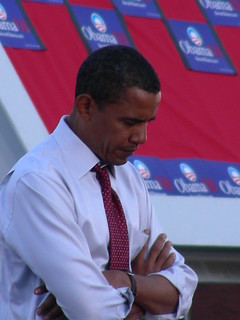 |
| Barack Obama (Photo credit: jamesomalley) |
Full article in new window





 Posts
Posts


