

 Stumble It!


The conservative interval: What did it accomplish?
This is a complimentary piece to my post-mortem on the election posted yesterday. The sections posted here are backward looking, to the record of Congress since 94; forward looking, to 2008, and a look at the record of populism as an issue. Very interesting. This author has a long record of meticulous election forecasting and analysis, and I have yet to see him get it wrong, including this time (ok I should have listened!). There is much more to the full article, and I urge that you all check it out...T
There are many more issues to address, but it is 3:40 a.m. and I am not going to address them all tonight. Let's look at it this way: The Republicans controlled the House for 12 years--the third longest period of Republican control in history (after 1895-1911 and 1861-75). Democrats of course had a majority in the House (though their leaders often didn't have control) for a far longer period of 40 years (1955-95) and also for a 16-year period (1931-47). But let's look back on the Republican period recently. What did they accomplish?
To answer that question, I think you have to look beyond Capitol Hill and consider the whole country. The big public-policy successes of the 1990s were welfare reform and crime control. Welfare dependency and violent crime were cut by more than 50 percent--more than anyone in 1990 thought possible. Key initiatives were taken not in Congress, but in the states and cities--on welfare reform by governors like Tommy Thompson, on crime control by mayors like Rudy Giuliani in New York City. Most of them were Republicans, but may were Democrats. Also, education reforms were undertaken, again more by Republicans (like George Bush and Jeb Bush in Texas and Florida) but also by some Democrats (like Jim Hunt in North Carolina). In all this, Congress and the Clinton and Bush administrations were interested and occasionally helpful bystanders. The Republican Congress passed welfare reform three times and, after Dick Morris told Clinton he had to sign it, he did so. Bush got a bipartisan majority to pass a federal education accountability bill that built on the successful actions of many states. Gun control, a federal initiative which had no realistic possibility of really reducing crime, was passed by a Democratic Congress in 1994. But the more realistic proposals, allowing law-abiding citizens to carry concealed weapons and therefore to deter violent criminals from attacking decent bystanders, have been making steady progress in the states to the point that they now hold sway in states with more than two thirds the nation's population.
The Republican Congress deserves great credit for resisting proposals to create the sort of government-run healthcare systems that are bankrupting Western Europe. The 1997 budget deal between Newt Gingrich and Bill Clinton cut the increases in healthcare expenses sharply; when that inspired protests against HMOs, the Republican Congress averted provisions that would have subjected them to regulation by government and predation by trial lawyers. Instead, employees exercised the option of exit (people who didn't like HMOs got out from under them). The Medicare prescription drug bill of 2003, a vast expansion of government entitlements, created a field of competition that dragged premium costs below expected levels, allowed grievants the option of exit and opened up the field of expanded options to high-deductible health savings accounts. The Democratic House will try to turn the clock back on these advances, but will probably not succeed during the next two years. The Democrats would like us to go slouching toward Scandinavia, even while Sweden and the Netherlands move in our direction to more healthcare options.
2008? The 2006 cycle has had some obvious implications for 2008. George Allen and John Kerry, for obvious reasons, have been swept from the field. That presumably helps Mitt Romney and Hillary Rodham Clinton. But Clinton's turnout efforts in New York didn't produce the upstate sweep she must have hoped for: John Sweeney lost for scandal-related issues, and the Democrats did pick up the Oneida County-centered open seat. But evidently nothing else. Barack Obama remains a threat to the obvious Clinton primary strategy: sweep the South, where blacks are a majority or near-majority in Democratic primaries. On the Republican side, John McCain appeared on Fox (and presumably other channels as well) lamenting that Republicans had lost their way by deserting conservative principles. Giuliani, who campaigned gamely and in an intellectually interesting way, for Republican candidates, was not to be seen.
A final note on populism. In cycle after cycle, we hear that certain forms of populism--full-throated opposition to immigration and free trade--will sweep all before them. The 2006 results, at least as I see them now, provide less than full-throated support for this proposition. Two of the loudest critics of illegal immigration--incumbent J. D. Hayworth and open seat primary winner Randy Graf, both in Arizona, where illegals have been famously streaming through the border--both evidently lost. And in upstate New York, where National Republican Campaign Committee Chairman Tom Reynolds was in terrible trouble after the Mark Foley scandal broke, his Republican-turned-Democratic opponent Jack Davis also lost, in a region where there had been a huge loss of manufacturing jobs. Nativism and protectionism are political weapons that in a certain light look very strong, which seem to be gleaming swords that will slay all before them. But, again and again, they crack like glass in your hand. If nativism can't work on the Arizona border, and protectionism can't work in upstate New York, where can they work?
Click here for full article
Friday, November 10, 2006
Thoughts from the Wee Hours of Election Night
Thursday, November 09, 2006
The Road Not Taken: Forfeiting a Majority
Mea Culpa
I can scarcely begin to tell you of the grief I've been getting from my Lib-friends. I admit, I thought we would squeak by this time, barely (and we almost did, in the Senate, and the House was under 30: bad, but recoverable, and modest in comparison to many 6 year itch elections), but I tempted fate by posting the last "race by race" prediction, as Mike pointed out quite sharply, and with sickly glee. Wow, was that off mark. With that being said, there is so much gobbledygook being spewed by the Drive-by's the last two days, that I thought a sober election post-mortem was in order. Here is the best one I've seen, with which I largely concur...T
The post-mortems are accumulating, but I think the obvious has to be stated: John McCain and his colleagues in the Gang of 14 cost the GOP its Senate majority while the conduct of a handful of corrupt House members gave that body's leadership the Democrats.
The first two paragraphs of my book Painting the Map Red --published in March of this year, read:
If you are a conservative Republican, as I am, you have a right to be worried. An overconfident and complacent Republican Party could be facing electoral disaster. Hillary Clinton, Howard Dean, and a host of others could be looming in our future and undoing all the good we've tried to do.
It is break the glass and pull the alarm time for the Republican Party. The elections looming in November 2006 are shaping up to be disastrous for the GOP as the elections of 1994 were for the Democrats. Most GOP insiders seem unaware of the party's political peril. Some are resigned to a major defeat as the price we have to pay for a decade of consistent gains, which, they think, couldn't have gone on forever.
As cooler heads sort through the returns, they will see not a Democratic wave but a long series of bitter fights most of which were lost by very thin margins, the sort of margin that could have been overcome had there been greater purpose and energy arrayed on the GOP's side. The country did not fundamentally change from 2004, but the Republicans had to defend very difficult terrain in very adverse circumstances. Step by step over the past two years the GOP painted themselves into a corner from which there was no escape. Congressional leadership time and time again took the easy way out and declared truces with Democrats over issues, which ought not to have been compromised. The easy way led to Tuesday's result.
The criminal activities of Duke Cunningham, Bob Ney and Mark Foley were anchors around every Republican neck, and the damaged leadership could not figure out that the only way to slip that weight was by staying in town and working around the clock on issue after issue. The long recesses and the unwillingness to confront the issues head on --remember the House's inexplicable refusal to condemn the New York Times by name in a resolution over the SWIFT program leak?-- conveyed a smugness about the majority which was rooted in redistricting's false assurance of invulnerability. Only on rare occasions would the Republicans set up the sort of debate that sharpened the contrast between the parties. In wartime, the public expects much more from its leaders than they received from the GOP.
In the Senate three turning points stand out.
On April 15, 2005 --less than three months after President Bush had begun a second term won in part because of his pledge to fight for sound judges-- Senator McCain appeared on Hardball and announced he would not support the "constitutional option" to end Democratic filibusters. Then, stunned by the furious reaction, the senator from Arizona cobbled together the Gang of 14 "compromise" that in fact destroyed the ability of the Republican Party to campaign on Democratic obstructionism while throwing many fine nominees under the bus. Now in the ruins of Tuesday there is an almost certain end to the slow but steady restoration of originalism to the bench. Had McCain not abandoned his party and then sabotaged its plans, there would have been an important debate and a crucial decision taken on how the Constitution operates. The result was the complete opposite. Yes, President Bush got his two nominees to SCOTUS through a 55-45 Senate, but the door is now closed, and the court still tilted left. A once-in-a-generation opportunity was lost.
A few months later there came a debate in the Senate over the Democrats' demand for a timetable for withdrawal for Iraq led to another half-measure: A Frist-Warner alternative that demanded quarterly reports on the war's progress, a move widely and correctly interpreted as a blow to the Administration’s Iraq policy. Fourteen Republicans voted against the Frist-Warner proposal --including Senator McCain-- and the press immediately understood that the half-measure was an early indicator of erosion in support for a policy of victory.
Then came the two leaks of national security secrets to the New York Times, and an utterly feckless response from both the Senate and the House. Not one hearing was held; not one subpoena delivered. A resolution condemning these deeply injurious actions passed the House but dared not name the New York Times. The Senate did not even vote on a non-binding resolution.
Nor did the Senate get around to confirming the president's authority to conduct warrantless surveillance of al Qaeda contacting its operatives in the United States. Weeks were taken up jamming the incoherent McCain-Kennedy immigration bill through the Judiciary Committee only to see it repudiated by the majority of Republicans, and the opportunity lost for a comprehensive bill that would have met the demand for security within a rational regularization of the illegal population already here.
And while the Senate twiddled away its days, crucial nominees to the federal appellate bench languished in the Judiciary Committee. The most important of them --Peter Keisler who remains nominated for the D.C. Circuit-- didn't even receive a vote because of indifference on the part of Chairman Specter.
(The National Review's Byron York wondered why the president didn't bring up the judges issue in the campaign until the last week, and then only in Montana. The reason was obvious: Senators DeWine and Chafee were struggling and any focus on the legacy of the Gang of 14 would doom DeWine's already dwindling chances while reminding the country of the retreat from principal in early '05.)
As summer became fall, the Administration and Senator Frist began a belated attempt to salvage the term. At exactly that moment Senators McCain and Graham threw down their still murky objections to the Administration’s proposals on the trial and treatment of terrorists. Precious days were lost as was momentum and clarity, the NSA program left unconfirmed (though still quite constitutional) and Keisler et al hung out to dry.
Throughout this two years the National Republican Senatorial Committee attempted to persuade an unpersuadable base that Lincoln Chafee was a Republican. For years Chafee has frustrated measure after measure, most recently the confirmation of John Bolton, even after Ahmadinejad threatened and Chavez insulted the United States from the UN stage. Chafee was a one-man wrecking crew on the NRSC finances, a drain of resources and energy, and a billboard for the idea that the Senate is first a club and only secondarily a body of legislators.
It is hard to conceive of how the past two years could have been managed worse on the Hill.
The presidential ambitions of three senators ended Tuesday night, though two of them will not face up to it.
The Republican Party sent them and their 52 colleagues to Washington D.C. to implement an agenda which could have been accomplished but that opportunity was frittered away.
The Republican Party raised the money and staffed the campaigns that had yielded a 55-45 seat majority, and the Republican Party expected the 55 to act like a majority. Confronted with obstruction, the Republicans first fretted and then caved on issue after issue. Had the 55 at least been seen to be trying --hard, and not in a senatorial kind of way-- Tuesday would have had a much different result. Independents, especially, might have seen why the majority mattered.
Will the GOP get back to a working majority again? Perhaps. And perhaps sooner than you think. The Democrats have at least six vulnerable senators running in 2008, while the situation looks pretty good for the GOP.
But the majority is not going to return unless the new minority leadership --however it is composed-- resolves to persuade the public, and to be firm in its convictions, not concerned for the praise of the Beltway-Manhattan media machine.
Click here for full article
Monday, November 06, 2006
Where’s The House?
Here's a race by race analysis showing a range of dem house pickups from 5-8 seats. Yes, thats right--5 to 8! not 15-20 (ehem, gallup, CNN). This election is likely to turn out just fine for us--IF WE VOTE!...T
Where’s The House III
My first post on analyzing the House races was two weeks ago and remains the basis for my final post on predictions today. As is my second post I did last week. In order to save a little time in the writing of this, I am just going to note in this post if any race has changed significantly from these previous posts. I am still only going to review reviewed the top RCP House races and felt that look like a risk to Dems or Reps, not all 50 RCP races!
Two week’s ago I predicted the Dems would pick up 6-9 seats. Last week I predicted the Dems would lose one seat in addition to the Reps looking better in one seat and modified the prediction to 5-8 seats. This is the final prediction, and sadly there are not a lot of new polls out at RPC today as I had hoped. But I need to get ready to take our two first graders out to dinner in celebration of their good grades! So onward we go.
I will only be applying the bias correction in heavily Rep districts, and possibly some 50-50 races. But I think districts that went for Kerry will see sufficient Dem voting to throw out and ‘cleanse’ their district. Liberals are mad, no two ways about it. So I see Kerry districts turning bluer, not matter what the GOTV effort can produce. One final change, I am dispensing noting the change in the RCP rankings - too many changes to keep track of. I will list the races in their current RCP rankings, making the top races in any category the least likely to stay in the category from the Rep point of view.
Probable Rep
NY-24: Open (Boehlert) - I have no idea why RCP put this race is in the high risk, likely to go Dem category. There are no recent polls to make this judgement and the district is strong Bush country. Going out on a limb here - there is no wave. My baseline is the political map is roughly the same as 2004 (high turn out). Stays Rep. If I am right, we will see it here tomorrow night.
NY-20: Sweeney - This is another race RCP dumped into their endangered Rep list for no good reason. The RT Strategy/CD Polls are showing a clear, consistent bias to the left. And they use unproven voice recognition polling. If I dump these I get an average Dem lead of less than 3% in a district that went for Bush. So the bias correction brings this to a bit over 2% for the Rep. A good GOTV effort and this one stays Rep.
IN-2: (Chocola - R) - Some polls show a drift towards Chocola. The average of the last three polls is around 5% and the bias correction would put it in the Toss Up category. But that Reuters Zogby poll looks crazy next to the other 4 polls, which have an average of 3.75% lead for the dems. I think Chocola will pull this out with a 2% win.
FL-13: (Open - R) - I dealt with this one in a previous post - stays Rep..
NM-1: (Wilson - R) - This race moved from Probable Dem to Toss Up and now is moving into Probable Rep (following its fall in the RCP ranking). Taking the last three polls and averaging brings it down to 1.3% Dem lead. The trend is towards Wilson and the Survey USA poll shows a lots of momentum. Wilson hangs on.
27. OH-1: (Chabot - R) - Few polls, all outdated but trending right. Trend looks to be with Reps. If the Dem wave fizzles it will dry up in this race. Stays Rep
CT-4: (Shays - R) - I almost moved this into the Rep column, but the inflated generic number stayed my hand. And that is really what is different this time around. Strong turnout numbers and the evaporating generic ballot leads. The average of the last three polls puts this a tie. And we should apply a small bias correction due to lack of polls right now. Shays takes this one with 3-4%.
IN-9: (Sodrel - R) - This one won’t even be close. Ignoring the obviously tilted RT Strategies poll and conservatively using the other four recent polls shows a dem lead of 2%. Applying the bias correction I think Sodrel wins with over a 3% margin
IL-6: (Open - R) - As with the others, there is one outlier that is tilting the average and needs to be deweighted. But even if you include it with the other four and average the lead is a measely 1.6%. Using the bias correction for this heavily Rep district gives Roskam a comfortable win with a margin that should exceed 3%
AZ-5: Hayworth - Another RCP drop in race. Many of the top 30 races moved out of contention, so RCP dropped some more in on some last minute polls. This race is averaging a tie and requires a 5% poll bias adjustment I would assume. I think Hayworth pulls this out by a coule of points.
CA-11: Pombo - Another new race to replace all those races that drifted right and out of reach of the Dems. We have one poll in a solid district. RCP is grasping here. Stays Rep
OH-2: (Schmidt - R) - Another new race (see a trend here) where the last two polls show an average of a 1% lead for the rep. If it wasn’t for the one Survey USA poll there wouldn’t even be a case to make this race a risk - unless the generic ballot numbers showed a massive Dem wave coming. But since there is no wave coming, then I would say this race stays Rep.
MN-6: (Open - R) - This one has gone beyond the Dems grasp. This use to be in the top 20 RCP rankings - not anymore. There is a sign here, for those willing to look.
22. CT-2: (Simmons - R) - This one appears to be sliding away from the Dems even in the RCP rankings.
WA-8: (Reichert - R) - I could put this in the toss up category, if there was a big Dem generic ballot lead out there to push me to. There is not one and even RCP has moved this down their risk list.
24. VA-2: (Drake - R) - This race should never have been added to the RCP risk list, but it was. Why? One outlier poll and the big Dem generic lead which made all races without complete consistency all of a sudden a risk. The latest polls show why this was never in play, but hindsight without the fear of a large dem lead in the generic allows for more clear thinking.
Toss Up
CO-7: (Open - R) - This race I held in the Probable Rep for a while because the polls seem to be all over the place. The last four polls give an average of 8.74%. If I ignore the latest one (yes, not a good thing to do) the average drops to just above 6%. This is still a strong BNush district, so the bias factor can be applied making this a 1-3% lead for the Dem, something a GOTV effort could overcome. So I am moving this to toss up with the expectation it could easily go Dem.
IN-8: (Hostettler - R) - The first round on this I said this race was a lost cause, then a poll comes out showing Hostettler only down by 7. Since then an RT Strategies poll has come out that seriously deviates from the numbers this district showed for Bush in 2004. I am not seeing that much change in the electorate, especially with the generic polls out yesterday that put the lie to one sided turnout models. I am loathed to keep this in the Toss Up category because the polls could be much tighter now. It is at least a toss up.
OH-18: (Open - R) -I am keeping this in the Toss Up category with reservations. Just because Bob Ney is a thieving scumbag doesn’t make the Rep running a crook (otherwise all dems wouldn’t be allowed near young female interns). Most voters are much more sophisticated than blaming a party for one man’s digressions. Plus the polls (minus a late and wild Zogby poll) show a 8% lead for the Dems, which could be as low as 3% if the bias correction is applied in this strong Bush district. We shall see what kind of people live in OH-08, but my guess is they are not the type to paint with a broad brush.
NC-11: (Taylor - R) I am moving this out of the Probable Dem category because (a) the latest Reuters Zogby poll puts the race at 5% and (b) that is a 50% cut in Schuler’s lead since the last Reuters Zogby poll. I think Schuler is heading for a loss with that trend line, but I will park it in the Toss Up category for tomorrow.
OH-15: (Pryce - R) - No recent polls and this is a 50-50 district. Pryceis a savvy incumbent and the GOP GOTV effort should do some magic here. But since we have nothing I am pulling this out of the Probable Dem (where RCP has it) since there is no information either way.
NH-2: Bass - This is the third poll RCP has air dropped into the at risk seats simply because of some wild polling anyone should have know to keep out of simplistic averaging of polls (without any weigting due to methodology, sample size, etc). The UNH polls have fluctuated wildly over the course of a few days - demonstrating they are useless. I was going to dump them all, but that seemed harsh so I averaged them into one fuzzy picture of an 8.75% dem lead. Then to not be unfair I averaged the UNH combined score with the two other polls from the period since averaging 9 with one seemed ridiculous. The race is between 1% and 4.5% - and I am tempted to apply the bias just because of the obvious problems with the UNH polls. I have so many doubts about this I going to stick it in the Toss Up, but it doesn’t really seem as an at risk seat to me. If The Dems do turnout in larger numbers they will get this seat. If the meet or fall behind the Reps it stays rep.
PA-6: (Gerlach - R) - This race remains in the Toss Up category. The district went marginally for Kerry, and the lead is slim across the last four polls. The Democrat poll shows the tightest of the four results. A good GOP GOTV could salvage this one, so it will be interesting to see.
CT-5: Johnson - This is one of the few late movers in the RCP rankings which looked legit. The race is about 5% points ahead for the Democrat, and it was a 50-50 district in 2004. New Toss Up.
Probable Dem
AZ-8: (Open - R) - This open seat is trending Dem, even though the district is heavily Rep. If you average the last three polls you get a lead over 10% for the Dem, which cannot be offset by the bias correction of 5%. Stays Dem
IA-1: (Open - R) - This is Kerry country, so the desire for partisan cleansing is strong. I don’t buy the polls showing 20% leads for the dems - it will not be that lopsided. But I plan to watch this race as an indicator for the entire election. Kerry beat Bush 53-46. If there is a wave Braley will beat this 7% margin of victory. And if there is not one he will tie it. And if there is a Rep GOTV wave he will fall short. Here is a bellweather - an open Republican seat in Dem country.
26. FL-22: (Shaw - R) -This is a race that illustrates some real issues with the RCP rankings. The polls show a solid Dem lead and the district is went for Kerry. It should be a strong Dem pick, but RCP has it in lean Rep. Go figure.
Special Factors
1. TX-22: (Open - R) - This is Delay’s old seat, but the Reps are fighting back and all the handwringing voters will not make the effort to write in for Sekula-Gibbs (see, how hard is that?) is an insult to American voters. Stays Rep
3. FL-16: (Open - R) - I am moving this to Probable Rep because it is clear the Reps can hold this and probably will. No new polls, but Floridians get to Punch Foley to elect Negron. Without any evidence to the contrary this goes Rep.
PA-10: (Sherwood - R) - Nothing new in this race poll-wise. The latest non-Democrat poll shows the race -9 for Sherwood. Applying the bias gives us -4. I am holding this in the Probable Dem.
NY-26: (Reynolds - R) - Another race that looked at risk in the flash of media hysteria (which no serious person should partake in) which is clearly trending Rep.
PA-7: (Weldon - R) - There are no recent polls in this race, but plenty of bipartisan scandal muck now that we have found ACORN has forged a lot of registrations. My guess is Americans just aren’t going to buy into this. We have one late poll with Weldon only down 7. Given this is a Democrat poll we can apply the bias factor and see this race as basically a tie, where GOTV can pull it out for the Reps.
So where has a week brought us? This week we have 4 probable Dems and 8 toss ups. This shows a further slippage in the Dems grip on a House majority. If the turnout models are now showing 50-50 turnout then we split the toss ups and the dems will only pick up 8 seats. If they sweep the toss ups they get 12. And if the Reps sweep the toss ups…Well, let’s just not go there for the sake of the liberal egos out there.
And as I pointed out this is without any Rep pick ups of a Dem seat - which is highly probable. There is GA-12 to consider. That would drop the Dem opportunities to 3-7 seats. I think Dems could lose LA-3 as well. As before, the dems could do better - but it has become very, very unlikely with their lead shrinking in the generic ballot and turn out reporting (not predictions) showing the GOP equaling or surpassing Dems in early and absentee ballotting.
Want to make some history? This is the election to do it, so get out and vote tomorrow.
Click here for full article
Sunday, November 05, 2006
November surprise, anyone?
One more generic moves, one more we're still waiting on
Another Poll moves in our direction. That's 3 out of 3 today, including Fox, ABC/WashPost and the before mentioned Pew research...T
11/05 03:49 PM
Hotline:
Pew is out with their final pre-election poll and just like the ABC/Wash. Post poll, Pew shows Republicans with momentum. In the generic ballot, Dems lead by just 4 points. More importantly, the GOP has made significant cuts into the Dems once gigantic lead among indies.
(The last Pew poll put the Democrats' generic ballot advantage at 11 points.)
They also report that 60 percent of voters heard "a lot" about Kerry's remarks, 24 percent "a little." That leaves Gallup's generic coming out tonight.
RCP:
Keep an eye on the Gallup generic ballot number coming out tonight, if it shows movement similar to the ABC/WP poll there could be a big surprise brewing for many people cocooned in Washington.
Click here for full article
Republicans Cut Democratic Lead in Campaign's Final Days
I'll stick with my prediction all along--small to medium Demo gains in both houses, Repubs maintain control of both. Pew has a late surge reducing the Demo lead from 11pts to 4pts--they question now whether any power shift will occur...T
A nationwide Pew Research Center survey finds voting intentions shifting in the direction of Republican congressional candidates in the final days of the 2006 midterm campaign. The new survey finds a growing percentage of likely voters saying they will vote for GOP candidates... The narrowing of the Democratic lead raises questions about whether the party will win a large enough share of the popular vote to recapture control of the House of Representatives.
Republican gains in the new poll reflect a number of late-breaking trends. First, Republicans have become more engaged and enthused in the election than they had been in September and October...as many Republican voters (64%) as Democratic voters (62%) now say they are giving quite a lot of thought to the election. About a month ago, Democratic voters were considerably more likely than GOP voters to say they were giving a lot of thought to the election (by 59%-50%). As a result, Republicans now register a greater likelihood of voting than do Democrats, as is typical in mid-term elections.
The Republicans also have made major gains, in a relatively short time period, among independent voters...
Click here for full article
Friday, November 03, 2006
Before Iraq: Remember the Hypocrites!
The assumptions of a forgetful chattering class are badly off the mark.
All I can say is Amen here! Read it, study it, print it, carry it in your hip pocket, but above all, remember it!...T
What is written about Iraq now is exclusively acrimonious. The narrative is the suicide bomber and IED, never how many terrorists we have killed, how many Iraqis have been given a chance for something different than the old nightmare, or how a consensual government has withstood enemies on nearly every front.
Long forgotten is the inspired campaign that removed a vicious dictator in three weeks. Nor is much credit given to the idealistic efforts to foster democracy rather than just ignoring the chaos that follows war -- as we did after the Soviets were defeated in Afghanistan, or following our precipitous departure from Lebanon and Somalia. And we do not appreciate anymore that Syria was forced to vacate Lebanon; that Libya gave up its WMD arsenal; that Pakistan came clean about Dr. Khan; and that there have been the faint beginnings of local elections in the Gulf monarchies.
Yes, the Middle East is "unstable," but for the first time in memory, the usual killing, genocide, and terrorism are occurring in a scenario that offers some chance at something better. Long before we arrived in Iraq, the Assads were murdering thousands in Hama, the Husseins were gassing Kurds, and the Lebanese militias were murdering civilians. The violence is not what has changed, but rather the notion that the United States can do nothing about it; the U.S. has shown itself willing to risk much to support freedom in place of tyranny or theocracy in the region.
Instead of recalling any of this, Iraq is seen only in the hindsight of who did what wrong and when. All the great good we accomplished and the high ideals we embraced are drowned out by the present violent insurgency and the sensationalized effort to turn the mayhem into an American Antietam or Yalu River. Blame is never allotted to al Qaeda, the Sadr thugs, or the ex-Baathists, only to the United States, who should have, could have, or would have done better in stopping them, had its leadership read a particular article, fired a certain person, listened to an exceptional general, or studied a key position paper.
We also forget that Iraq, contrary to popular slander, was not "cooked up" in Texas or at a Washington, D.C., neocon think tank. Rather, it was a reaction to two events: a decade of appeasement of Middle East tyrants and terrorists, and the disaster of September 11. If one were to go back and read the most popular accounts of the first Gulf War, The Generals' War by Michael Gordon and Bernard Trainor of Cobra II fame, or Rick Atkinson's Crusade, or research the bi-partisan arguments that raged across the opinion pages in the 1990s following the defeat and survival of Saddam Hussein, certain themes reappear constantly that surely help to explain our current presence inside Iraq.
One was shared regret that Saddam was left in power in 1991. No sooner had the war ended than George Bush Sr. appeared, not joyous in our success, but melancholy, and then distraught, once images of the butchered and refugees beamed back from our "victory" in Iraq. Culpability for thousands of dead Shiites and Kurds, the need for no-fly zones, and worry about reconstituted WMD were the charges then leveled.
The heroes? A troubled former Pentagon official Paul Wolfowitz (read The Generals' War) who almost alone felt tactical success had not translated into strategic victory, and that we were profoundly amoral to have let a mass murderer remain in power, while thousands of brave revolutionaries were butchered just a few miles away from our forces.
We praise the first Gulf War now. Yet, almost immediately in its aftermath, critics accused us of overkill, of using too many soldiers to blast too many poor Iraqis. The charge then was not that we had too few troops, but too many; not that the Pentagon had understated the need for troops, but overstated and sent too many; not that we had too few allies, but an unwieldy coalition that hampered American options; not that the effort was too costly, but that we were too crassly commercial in forcing allies to pony up cash as if war were supposed to be a profitable enterprise.
The generic criticism in the 1990s of the United States, both here and abroad, was that America bombed from on high, and sometimes, as in Belgrade or Africa, even indiscriminately -- its only concern being fear of losses, not worry over civilian collateral damage or ending the war decisively on the ground. Indeed, in Europe there was voiced a certain cynicism that we were cowardly turning war into an antiseptic enterprise (the "body bag syndrome"), adjudicated only by our concern not to engage with the enemy below.
There were other issues now forgotten. After the acrimony in the debate over Iraq in 1990, followed by the successful removal of Saddam Hussein, Democrats were determined never again to be on the wrong side of the national security debate. So they supported the present war because they were convinced that after Panama, Gulf War I, Bosnia, Kosovo, and Afghanistan, they could regain credibility by supporting muscular action that seemed to pose little risk of failure. That is why only recently have Democratic supporters of the war bailed -- and only when polls suggested that any fear of "cut and run" or McGovernism would be outweighed by tapping into popular dissatisfaction with Iraq.
Realism is much in vogue these days, with James Baker returning as the purported fireman, and even Democrats demanding talks with horrific dictators in Iran and North Korea. That was not the mantra of the 1990s. The Reaganism that rejected Cold War realpolitik and risked brinkmanship to bring down a rotten and murderous Soviet Empire was considered both the wiser and more ethical stance, as even Democrats reformulated their opportunistic criticism after the fall of the Berlin Wall. Mutually Assured Destruction, Kissingerian tolerance for the status quo, and mere containment -- all that was scoffed at in the afterglow of Reagan's squeeze that popped the Soviet bubble.
Not long ago, abdication -- from Rwanda or Haiti, or from the Balkans for a decade — not intervention, was the supposed sin. There were dozens of Darfurs in the 1990s, when charges flew of moral indifference. The supposition then -- as now -- was that those who called for boots on the ground to stop a genocide would not unlikely be the first to abdicate responsibility once the coffins came home and the military was left fighting an orphaned war.
Apparently all the high-minded talk of reform -- Aristotle rightly scoffed about morality being easy in one's sleep -- was predicated only on cost-free war from 30,000 feet. Now the wisdom is that Colin Powell -- the supposed sole sane and moral voice of the present administration -- was drowned out by shrill neocon chicken hawks. But that was not the consensus of the 1990s. In both books and journalism, he was a Hamlet-like figure who paused before striking the needed blow, and so was pilloried by the likes of a Michael Gordon or Madeline Albright for not using the full force of the American military to intervene for moral purposes. That was then, and this is now, and in-between we have a costly war in Iraq that has taken the lives of nearly 3,000 Americans.
The unexpected carnage of September 11 explains so much of our current situation. It has made the realist, neo-isolationist George Bush into an advocate for Wilsonianism abroad, but only on the calculation that the roots of Islamic fascism rested in the nexus between dictatorship and autocracy -- the former destroys prosperity and freedom, and the latter makes use of terrorists to deflect rising popular dissatisfaction against the United States.
The U.S. Senate and House voted for war in Iraq, not merely because they were deluded about the shared intelligence reports on WMD (though deluded they surely were), but also because of the 22 legitimate casus belli they added just in case. And despite the recent meae culpae, those charges remain as valid today as they were when they were approved: Saddam did try to kill a former American president; the U.N. embargo was violated, as were its inspection protocols; the 1991 accords were often ignored; the genocide of brave Kurds did happen; suicide bombers were being given bounties; terrorists, including those involved into the 1993 World Trade Center bombing, were given sanctuary by Saddam; and on and on.
So it is not those charges, but we who leveled them, that have changed. Americans' problem with the war is not that it was not moral, but that it has been deemed too costly for the perceived benefits that might accrue.
The conventional wisdom was that, after Afghanistan (7 weeks of fighting) and its postbellum stability (a government within a year), a more secular Iraq (3 weeks of fighting) would follow the same timetable. In September 2002, well after the "miracle" in Afghanistan, I listened to a high-ranking admiral pontificate that war on the ground was essentially over in the new age of Green Berets and laptops, that after Bosnia and Afghanistan, air power and Special Forces were all that were needed.
This did not come from Rumsfeld surrogates, but was a fair enough reflection of the wild new intoxication before Iraq -- that a supposed "revolution in military affairs" had changed the ancient rules of war, as if our technology would now give us exemption from hurt. Many of those who now most shrilly condemn the war had in fact years ago rattled their sabers for "moral" wars to eliminate dictators -- predicated on just this foolish utopian notion that GPS bombing and laser-guided missiles had at last given us the tools needed for removing the tumors with precision and at little cost, as we conducted lifesaving moral surgery on diseased states.
No, nothing has changed about Iraq other than its tragic tab. Changes of view are fine, as long as those who now criticize the effort at least acknowledge the climate in which fighting in Iraq was born, and the real conditions under which they themselves once supported the war -- and lost heart.
Click here for full article
Dig Through Zogby Numbers
I agree with Morris here. This race will come down to one question: Do our "all or nothing" single issue voters want us to win, or are they going to sit it out, so to "send a message"? I remain optimistic. We retain the Senate, and I think the house as well, although it may be just a couple of seats. Those couple of seats may mean victory in the war against Islamo-Fascism in the near future, instead of decades from now, if the demos win...T
Can the Republicans win control of Congress? They can if they want to. It is up to the vaunted GOP base.
According to the Zogby poll, Republican fortunes, while improving in early October, have fallen since. On Sept. 22, Democrats led in the generic vote poll (Do you plan to vote for the Democratic or the Republican candidate in your district?) by nine points, 42-33. But by Oct. 11, their margin was only three — 37-34. But by Oct. 24 it was back up to 11 points — 44-33 — enough for the Democrats to take control of the House and probably the Senate.
But if you dig deep into the Zogby poll, you find an astonishing fact — independents are turning to the Republican Party while Republican base voters are leaving it.
Among independents, the percent that plan to vote Republican has risen from 15 percent on Sept. 22 to 23 percent on Oct. 11 to 26 percent on Oct. 24. While independents are still voting for more Democrats, it's only by 38-26 compared with 38-15 last month.
But as the Republican Party has gained among Independents, it is losing its base. Republicans who plan to vote Republican in 2006 have dropped from 75 percent on Sept. 22 to 72 percent on Oct. 11 to 68 percent on Oct. 24. Obviously the impact of the Foley scandal has yet to diminish among the morality-minded Republican base.
Historically, the Republican Party is able to attract much more support from its base than the Democrats. But now Democrats are more loyal than Republicans. On Sept. 22, Zogby had 82 percent of the Democrats voting Democrats and 75 percent of Republicans voting Republican. By Oct. 11, party loyalty on both sides had dropped and only 76 percent of Democrats voted their candidates and 72 percent of Republicans backed their party.
But by Oct. 24, Democrats had come back to their party and 81 percent were voting for its candidates while only 68 percent of Republicans were loyal to their ticket.
GOP problems with their base should be curable since Republicans largely agree with their party on all the major issues. Their disloyalty stems from the failure of the Republican Congress and President Bush to pass their agenda and concerns over financial and morality scandals in Washington.
If talk-radio show hosts, cable news stations, and the White House do what they do best – talk to their base – they should be able to turn the situation around. But so far their efforts have been unavailing.
But the Democrats have their problems too. Despite their huge national edge they are not leading in the key Senate races. For example, in New Jersey, Rasmussen's polls have the race between Republican challenger Tom Kean and Democratic Sen. Robert Menendez tied. But, in the same survey, New Jersey voters want Democratic Party control of the Senate by 54-36. So while the party is winning by 18 points, its candidate can manage no better than a tie.
And despite the national trend toward the Democrats, Missouri Republican Sen. Jim Talent still clings to a 50-48 lead over Democrat Claire McCaskill. Likewise in Tennessee, Rasmussen has Republican Bob Corker leading Democrat Harold Ford by 50-48.
To control the Senate, Democrats must win two of these three: New Jersey, Tennessee and Missouri and so far, they trail in two and are tied in the third.
Why are Democrats trailing so far behind the national party trend? Because Republican negative ads are working so well and the GOP financial advantage is making itself felt in individual races.
The Democrats, dragged down by their suicidal decision to install the fundraising challenged Howard Dean as national chairman, are simply finding it hard to compete on the airwaves in key states. Even Clinton crony Harold Ickes's much heralded effort to fund Democratic races has fallen far short of its fund-raising goals, having raised only $3 million of the projected $10 million for which he had hoped.
So voters in swing states are saying: "I want the Democrats to win, just not the guy running in my district." It is still too early to tell if the national Democratic trend will assert itself in the end or whether the Republicans can pull out the swing districts. But the key will be whether the GOP base itself genuinely wants a Republican Congress or not.
Click here for full article
Tuesday, October 24, 2006
CNN and the October Surmise
The MSM, drive-by-media traitors are at it again. CNN embeded with terrorist snipers? video-taping the assassination of US troops? Try them. Execute them. At the very least revoke their visa's and deport them. Am I alone here? A Traitor is a Traitor, no?...T
With this post about Marine 2nd Lt. Joshua Booth, a sniper victim, Gateway Pundit captures the widespread revulsion at CNN's decision to air enemy propaganda, which it admits is enemy propaganda: a terrorist sniper killing an American. Wolf Blitzer lamely attempted to explain to House Armed Services Committee Chairman Duncan Hunter yesterday that CNN blacked out the frames where the GI gets hit and goes down. Hunter wasn't buying it, and neither are the vast majority of Americans.
CNN has thus triggered not an October surprise but an October surmise: We are in a war but elite media and much of the Democratic Party is indifferent to victory in that war, and genuinely incapable of regulating themselves and their behavior so as to maximize the chance of victory. Now a leading network is airing a snuff film from the terrorists, which follows a year in which newspapers have compromised both our electronic surveillance of terrorists communicating with their operatives in the US, and our tracing of terrorist money flows, stories which in both instances undeniably assisted terrorists in eluding capture.
The enemy is trying for a Ramadan version of the Tet offensive, and generally succeeding because even as was the case in 1968, the media and the left have no desire to understand much less report on the reality of the enemy and their tactics, but is instead in love with the idea of American defeat. Nancy Pelosi announces on 60Minutes that her goal is to make Bush and Cheney "lame ducks." There's a platform for you: The Party of Paralysis at Home and Defeat Abroad, supported by a MSM committed to showing the enemy's best side and our worst.
The Tet offensive claimed 4,324 killed, 16,063 wounded, and 598 missing among U.S., South Vietnamese and South Korean forces. Approximately 45,000 of the enemy were killed, and their offensive shattered. The communist butchery was vast, and in the city of Hue alone, 2,800 were murdered and another 2,000 went missing. The Viet Cong were in fact shattered, but that message never got home to America.
The enemy in fact won an enormous propaganda victory, including the famous photograph of General Nguyen Ngoc Loan executing a Viet Cong prisoner in Saigon. On February 27, 1968, Walter Cronkite presumed to throw in the towel for America, and the seeds of the genocide of a few years later were sown.
Now there is a Tet sequel underway, and the same players --the elite media and the Democratic Party-- want the same ending: Another quick exit and another long bout of self-flagellation over the limits of American power.
This time, though, the enemy will not stay in the land we leave. 9/11 showed us that, and if you want the details, consult Lawrence Wright's The Looming Tower.
It was possible for Democrats and the MSM to claim in the late '70s that they had no idea what we had abandoned southeast Asia to.
No such claim can be made about the aftermath of a defeat in Iraq or anywhere in the war against Islamist fascism.
Our eyes are wide open, watching terrorist snipers gunning down America's finest, and reading state secrets on the front page.
Click here for full article
Democrats Post Election Plans: Revealed!
ZUCKER UNCENSORED TAXMAN AD
Democrats post-election plans revealed...shhh!...T
'06 ELEX: BACK TO TOSS-UP, from the Worst skeptic!
More in the same vein of what I have been posting...and this from Dick Morris of all people, who had been predicting a Demo sweep for weeks, if not months, until now!...T
October 24, 2006 -- The latest polls show something very strange and quite encouraging is happening: The Republican base seems to be coming back home. This trend, only vaguely and dimly emerging from a variety of polls, suggests that a trend may be afoot that would deny the Democrats control of the House and the Senate.
With two weeks to go, anything can happen, but it is beginning to look poss- ible that the Democratic surge in the midterm elections may fall short of control in either House.
Here's the evidence:
.......
Click here for full article
Friday, October 20, 2006
The undertow has arrived
Ok, enough speculation. Let's talk numbers, raw data. You still think a huge Dem sweep is coming? Read on, my friends, you won't be sorry...T
My new Townhall.com column is here, and my new World Magazine column is here.
Both relay the results of my reporting from four battleground states --Minnesota, Colorado, Pennsylvania and Ohio-- over the past five days. There isn't credible evidence of a significant depressed turnout among Republicans generally or evangelicals specifically. Lots of quotes from lots of self-annointed experts on turnout, and lots of secret sauce in the polling models, but no evidence of actual base voters deciding to stay home. Much contrary evidence in terms of metrics achieved and sampling of crowds and candidates.
Though the polls are all over the place, I note the latest on Tom Reynolds' race in New York's 26th CD. SurveyUSA now has Reynolds up three.
And Rasmussen puts Burns within 3 of Tester.
Three weekends of GOTV and 18 days of campaigning left, and the Dem surge is fading fast. Talk is cheap. GOTV is expensive. The Dems have the former, the Republicans the latter.
UPDATE: Doug Ross has the ilustrated guide to a Pelosi Speakership.
UPDATE: A Memo from Mehlman on the subject:
In recent days and weeks, the mainstream media have repeatedly claimed that the Republican base is suffering from "low voter enthusiasm." It is easy to believe a story that is repeated so frequently, but in fact there is ample evidence to the contrary. By many measures, there are strong indications of a right-of-center base that is engaged and committed.
First, numerous polls clearly indicate near parity in intensity between Democrats and Republicans. Three recent national surveys-Gallup, Cook/RT Strategies, and our most recent RNC survey conducted by Voter/Consumer Research-all show partisan interest is approximately equal. The details of those polls are below:
Voter/Consumer Research (Oct. 8-10)
The RNC's internal research shows election interest at 7.7 on a 10-point scale among Republicans and 7.6 among Democrats, unchanged from late September and in line with this year's overall trend.
Gallup (Oct. 6-8)
To quote from Gallup's voter turnout projection, "Gallup's latest analysis suggests Republicans and Democrats are now roughly even in terms of anticipated turnout in the midterm congressional elections. The voting intentions of the large pool of registered voters is now similar to the voting intentions of the smaller pool of likely voters, showing no disproportionate impact of turnout in either direction"
Gallup asked, "How motivated do you feel to get out and vote this year -- extremely motivated, very motivated, somewhat motivated, not too motivated or not at all motivated?(% "extremely" or "very" motivated)" The following table shows that the GOP in fact now holds a slight lead, up from just a few months ago:
....................................GOP DEM NET
Sept 15-17, 2006 .......... 70% 67% +3
Jun 23-25, 2006........... 74% 77% -3
Oct 3-6, 2002............... 65% 55% +10
Oct 29-Nov 1, 1998....... 59% 57% +2
Oct 23-25, 1998............ 67% 56% +11
Oct 9-12, 1998.............. 59% 53% +6
Sep 23-24, 1998........... 73% 62% +11
Cook/RT Strategies (Oct. 5-8)
On a scale of one to 10, Republicans and Democrats have almost equally high mean election interest scores (8.2 for Republicans, 8.1 for Democrats), but Democrats hold a slight edge in the percentage of their voters who are "highly interested"-47 to 51 percent.
However, keeping in mind the local nature of midterm elections, it is more important to consider intensity by state or congressional district. RT Strategies/Constituent Dynamics (conducted Oct. 8-10) released district-by-district polling showing Republicans have a slight edge in partisan intensity. GOP "voter motivation" is higher than Democratic motivation in 19 of 32 competitive House races, in some cases by as much as a full point on a 1 to 9 scale. Democratic intensity is higher in the remaining 13, and in none of those races is the difference higher than 2/3 of a point.
Additional Data
A recent Pew study (9/21-10/4) found that while roughly similar numbers of Republicans (41%) and Democrats (39%) are "regular" voters, more Republicans (25%) than Democrats (20%) vote intermittently--meaning there are more of our voters for us to turn out in a midterm election. Furthermore, Democrats (20%) are substantially more likely than Republicans (14%) to not be registered to vote at all.
Other Measures of Intensity
There are ways besides polls to measure the intensity of the Republican base, and those also indicate that GOP voters are strongly engaged. Fundraising, for example, is often called the "first ballot" for the simple reason that supporters only donate when they are involved and enthusiastic. That is why we are excited that the RNC received support from 362,000 new donors this cycle. We've averaged 8,256 contributions for each deposit day so far this year. We just announced that September has been our best financial month of the entire cycle. Our supporters know how important this election is, and their financial support shows it.
Volunteer enthusiasm is another key measure of intensity. Again, every indication here is that our base is working hard for victory in the 2006 election. Republican volunteers have contacted more than 14 million voters this year, and more than 7 million since Labor Day alone. We have made 1 million voter contacts every week for the past five weeks, and for six weeks we have surpassed the number of contacts we made at comparable times in 2004, a presidential election year.
The Bottom Line
Despite the media hype, an examination of all the facts makes it clear: the Republican base is active and engaged. No matter how you measure it--whether by record-breaking fundraising, unprecedented volunteerism, or scientific polling--the numbers show that Republicans understand the importance of the choice we all face on November 7.
Click here for full article
Sunday, October 15, 2006
White House Upbeat About GOP Prospects
Now, I believe that, in every election in the past several decades, congressional races have significantly under-polled the Republicans. This happened most recently in 2000, 2002, and 2004. These facts are undeniable. Why should this year be any different? I trust the opinions of the experts I have been posting, here, much more than Gallup, or Zogby, who have been proven partisan in the last several election cycles. I trust the men quoted herein a great deal more than the blathering, simpering, rabidly drooling, Drive-By-MSM...T
Amid widespread panic in the Republican establishment about the coming midterm elections, there are two people whose confidence about GOP prospects strikes even their closest allies as almost inexplicably upbeat: President Bush and his top political adviser, Karl Rove.
Some Republicans on Capitol Hill are bracing for losses of 25 House seats or more. But party operatives say Rove is predicting that, at worst, Republicans will lose only 8 to 10 seats -- shy of the 15-seat threshold that would cede control to Democrats for the first time since the 1994 elections and probably hobble the balance of Bush's second term.
In the Senate, Rove and associates believe, a Democratic victory would require the opposition to "run the table," as one official put it, to pick up the necessary six seats -- a prospect the White House seems to regard as nearly inconceivable.
The Mark Foley page scandal and its fallout have many Republicans panicked, but Rove professes to be taking it in stride. "The data we are seeing from individual races and the national polls would tend to indicate that people can divorce Foley's personal action from the party," he said in a brief interview Thursday.
The official White House line of supreme self-assurance comes from the top down. Bush has publicly and privately banished any talk of losing the GOP majorities, in part to squelch any loss of nerve among his legions. Come January, he said last week, "We'll have a Republican speaker and a Republican leader of the Senate."...continued
Click here for full article:
A Voice of Sanity
Amen, and let's hope it is so....T
A Voice of Sanity, That's Donald Lambro, who surveys the electoral scene and sees the Republicans with strong issues to take to the voters:
President Bush and his party have made it clear that the final weeks of the elections will be about two issues: national security and the economic recovery.
The war in Iraq, and our efforts to help the Iraqis' fledgling democracy overcome its terrorist insurgency, is the administration's biggest political challenge right now. Still, polls show a 51 percent majority believes Iraq is a key battle in the war on terrorism, and most Americans, 50 percent to 42 percent, say the country is safer today than it was before Sept. 11.
Meanwhile, a growing economy is fast emerging as a big political plus for Bush and his party that they intend to promote for all it's worth.
In any normal election cycle, a booming economy and an edge on national security would be considered a winning hand. But this year, the hysteria that the Democrats and their allies in the news media have generated has swept away all rational consideration of the issues. If you believe the newspapers, that is, and to some degree the polls.
As I've said before, I assume the Republicans will lose seats in November, and the Democrats may well wrest away control of one or even both houses. Still, I wonder: the news media have gone stark, raving mad over Mark Foley's emails, and generic preference polls seem to indicate that the Foley "issue"--whatever it is--has helped the Democrats. But, to the extent that people are offended (as they should be) by homosexual Congressmen hitting on teenage boys, does anyone seriously believe that the solution is to elect Democrats? I doubt it. Democrats are far more associated with both homosexuality and sexual misbehavior than Republicans.
Likewise with the economy. The media have tried to minimize our current prosperity. But can they really succeed in doing that, when people see the prices at which homes in their neighborhood sell, watch prices fall at the gas pump, and enjoy both salaries and stock markets indices that are the highest on record? More and more Democrats are coming out into the open about their intention to raise taxes. How many voters believe that is the way to maintain our current prosperity? Very few, I think.
Newspapers love to headline "More Abuse Alleged at Gitmo!"--more about that later--and Democrats seem to think "detainee abuse" is a winning issue for them. Well, maybe.
But most Americans understand that when we capture a member of al Qaeda who has knowledge of that organization's plans, potentially including imminent attacks and the whereabouts of other members, it is important to question that detainee quickly and find out what he knows. There is a clear consensus that torture is not an acceptable tactic. But the Democrats and the newspapers consider pretty much everything to be "torture." Most Americans realize that we can't get information from a terrorist by saying "pretty please." What, exactly, are we supposed to do to protect American lives? The Democrats have no answer. Likewise, if we are to house detainees at a facility like Guantanamo Bay, or any other facility, the guards must have a reasonable degree of control over the prisoners. The prisoners frequently attack guards and misbehave in other ways. Once again, does anyone seriously think that all a guard has to do is ask a detainee to please get back in his cell?
This is the most topsy-turvy election season in memory, with trivia largely predominating over the very serious issues that divide the parties. The media's full-court press may well succeed in pushing the Democrats over the finish line. Still, it would be odd for voters to completely ignore the fundamentals of economics and national security that normally drive elections. Which, I think, is one of the reasons for the hysterical tone of today's news coverage.
Click here for full article
Friday, October 13, 2006
Are the Democrats Whigging Out?
In an very prescient article, this piece lays out what I have been predicting for some time now, namely, that the democrats have no where to go, politically and ideologically. The break up of their party, demographically, is the most likely outcome in the long term, and even possible in the near future...T
Predicting what will happen if the Democrats win control in one or both houses of Congress next month is a burgeoning cottage industry. It is, however, both more interesting and probably more useful to consider what will happen if they don’t.
If Democrats win they will crow and bray and make nuisances of themselves with frivolous, ankle-biting investigations. They may even connive with the White House and some foolish Republican legislators to enact “comprehensive immigration reform.” If they do, the principal effect will be to turn our illegal immigration problem into a crisis, creating a major political opportunity for the next generation of GOP leaders. Aside from that, very little will change.
Democrats are too conflicted and too politically timid to force any significant change in the Bush administration’s foreign and defense policies. They frittered away their dominant position in American politics by procuring the Ford administration’s surrender in Vietnam. Ever since, they have been crippled by the widespread (and entirely accurate) perception that they are not to be trusted with our national security. They may belong, body and soul, to the lunatic left, but most of them are not about to step over the same cliff twice.
In any case, having stepped over that cliff in the 70’s, the Democrats are very unlikely to win either house of Congress in 2006. The American people may loathe the Republican Party every bit as much as the Washington Post thinks they do, but nothing in our history suggests that a majority of American voters is crazy enough to trust Democrats with significant power during a war.
The headlines of the moment are orchestrated to create the appearance that a Democrat restoration is at hand. After the news industry has prepared them for victory in the run up to three consecutive electoral defeats, the Democrats should be wary. Many, probably most, of them are not. They have made the mistake of believing their own propaganda yet again.
In the likely event that Democrats wake up on the Wednesday after the first Tuesday in November and find that the federal government is firmly in Republican hands for another two years how will they react? After licking their wounds by dabbling in deranged conspiracy theories about election fraud, they will fall to fighting among themselves like starving sled dogs. There will be casualties. Howard Dean, Nancy Pelosi and Harry Reid will all have trouble keeping their jobs in the wake of yet another failure.
In the ensuing succession struggles the deep divisions in the Democrat Party will be laid bare. Some Democrats will claim that the party must take the war more seriously and appear more moderate to win. Others will argue that the party must be true to its ideological roots on the far left so that it may win a majority by the power of passion and persuasion. Neither side of this debate will grasp the true nature of the Democrat dilemma.
The would-be moderates don’t understand that Democrats can’t win without the left. The ideological purists don’t understand that Democrats can’t win with it.
If the Democrats ceased to be the leftist party they would lose their all-important propaganda apparatus in the heirloom media. They would lose all their intellectual firepower (such as it is) in the universities and all the cachet of Hollywood. Their fundraising base would disappear. They would become a me-too party relegated to winning elections in most of the country only when the Republican candidate got caught in bed with either a live boy or a dead girl.
As essential as the left is to Democrats, it can’t muster anything approaching a nationwide majority. This is hardly surprising. The left is anti-American and most Americans aren’t.
The left is defined by it’s loyalty to a trans-national ideal. Nation states in general and the United States in particular are obstacles to the realization of that ideal. Whenever the interests of the United States and the ideological purposes of the left conflict, which is often, American leftists work against their own country.
Consider, for example, the grotesque foolishness of Kyoto and the left’s determined efforts to undermine our ongoing war for national survival. Even the dimmest voter can smell the contempt leftists have for ordinary people and for everything they hold dear. The more voters understand that Democrats are the political wing of the American left, the fewer votes they will cast for Democrats.
Professional Democrats have tried for years to have their cake and eat it too. They have tried to keep the loyalty of the left without getting identified with it. That worked during the ersatz peace of the Clinton years when they were still winning, at least sometimes.
The pressure of war and defeat has made it much more difficult for Democrats to have it both ways. They have tried desperately to straddle the divide between those who want to defend America from our deadly enemies and those who don’t. John Kerry made an ass out of himself trying to bridge that gap and then discovered that Americans don’t really want an ass in the White House.
Since Kerry went down in flames, canny Democrats have tried to say very little about the war but to say it as indignantly as possible. They have been in tune with the left’s anger without overtly adopting its politically poisonous defeatism. This tightrope act isn’t likely to work for them any better than Kerry’s contortions did.
After yet another defeat even the Democrats may finally grasp that they can’t have it both ways. They can follow Joe Lieberman’s path and stand for American interests at the price of parting ways with about half their voters. They can also follow Ned Lamont and stand up for the left at the price of losing the other half. Either choice would mean that the Democrat Party could no longer seriously contend for a share of power in national elections.
This isn’t the first time a major American political party has been closely divided over a defining issue. The Democrats’ dilemma in 2006 looks a lot like the Whigs’ dilemma in 1852. The Whigs depended on support from both slave holders and abolitionists. They tried to straddle the slavery issue but they couldn’t. Their party broke apart and disappeared.
The Democrats have much deeper roots than the Whigs, who lasted only 24 years. They are likely to linger in some form for quite some time. But one more unexpected defeat just might tear them apart and prompt a dramatic political realignment.
At some level, Democrats seem aware of this danger. They are fighting the 2006 campaign like the existential struggle which, for them, it may very well be. It smacks of desperation, to choose an example at random, when the party of pederasty attacks Republicans for failing to condemn a homosexual congressman in advance of any evidence that he did anything wrong.
The political game has never been a better spectator sport and the stakes have rarely been higher.
Click here for full article
Tuesday, October 10, 2006
The David Zucker Albright Ad
The David Zucker Albright Ad. I'd run this one all day, in a heartbeat. It's true, after all. They run adds acusing Bush of lynching black men, run stories fabricated on CBS, and spread rumors acusing Bush of fabricating the 9/11 attacks. Run the add!..T
Saturday, October 07, 2006
A Tale of Two Ads: The real choice this November
"It shocks the conscience. Congressional leaders have admitted covering up the predatory behavior of a congressman who used the Internet to molest children. For over a year, they knowingly ignored the welfare of children to protect their own power. For 17 years, Patty Wetterling has fought for tougher penalties against those who harm children. That's why she's demanding a criminal investigation and the immediate expulsion of any congressman involved in this crime and coverup."
--TV ad on behalf of Patty Wetterling, Democratic candidate in Minnesota's 6th Congressional District
"A call is placed from New York to a known terrorist in Pakistan. A terrorist plot may be unfolding. Should the government intercept that call or wait until the paperwork is filed? Nancy Johnson says: 'Act immediately. Lives may be at stake.' Liberal Chris Murphy says: 'No. Apply for a court warrant even if valuable time is lost.' Chris Murphy -- wrong on security, wrong for America."
--TV ad on behalf of Nancy Johnson,Republican candidate for reelection in Connecticut's 5th Congressional District
There you have it. These TV ads in two competitive House races tell the story. Repelled by former Republican congressman Mark Foley's sexual overtures to congressional pages and ex-pages, and by the House GOP leadership's alleged failure to move aggressively against him? Vote Democratic. Worried about the Demo crats' tendency to coddle jihadists? Vote Republican.
This is a choice that should work out fine for Republicans. Which is why Democrats and the media may look back on the frenzy about Foley as a tactical mistake. In a time of disturbing foreign news--apparent lack of progress in Iraq, North Korea's threat of a nuclear test, Pakistan's cutting a deal with al Qaeda, Iran's nuclear program chugging ahead--the assault on the Republicans focused on a disgraced and departed congressman and the unquestionably decent speaker of the House, Denny Hastert.
Foley is a creep. The House leadership might have stumbled in dealing with him. But even the Washington Post commented that Wetterling's ad "seriously overstates what is known about the actions of the House Republican leadership." Will voters really be convinced that Denny Hastert "knowingly ignored the welfare of children to protect [his] own power?" From what we know, Hastert didn't find out about Foley's lurid behavior until a week ago, and then Foley was quickly gone. And how exactly did ignoring Foley's behavior help protect GOP power? His district is a safe Republican seat (except now, when Republicans are stuck with Foley's name on the ballot).
The attempt to make Foley a key issue in this fall's election is flopping. It's not credible to tar a political party with the misdeeds of one person. Did Republicans, for example, even try to link Gary Condit to other Democratic candidates in 2002? Was anyone really interested in Condit's party affiliation? Of course not.
And voters aren't in Foley's. National polls taken last week were basically unchanged from pre-Foley polls--bad for the GOP, but not irredeemable. And in the two competitive House races in Florida districts near Foley's, where there was of course saturation coverage of the story, the Republican candidates happened to gain ground last week.
There's no roll call vote in which the parties split on the behavior of Mark Foley. But there have been recent votes in which the parties divided on terror interrogations and (in the House) eavesdropping. On interrogations: Virtually all Republicans voted for tough interrogations of terrorists, and more than three-quarters of Democrats voted against. On supporting the administration's program of warrantless surveillance: Republicans in the House voted 214-13 for, Democrats 177-18 against. The Nancy Johnson advertisement may oversimplify things, but it captures a basic difference between the parties. That's why it has been effective. Johnson has opened a sizable lead on her opponent since the ad started running.
Issues usually trump scandals. Americans like reading about scandals. They like watching Desperate Housewives. But voting is different from voyeurism. The Republican landslide of 1994 was helped along by earlier congressional scandals--but it was basically ideological, following a campaign focused on Clinton's health care plan, his tax hike, gays in the military, gun control, and the like.
After a few days of panic last week, House Republicans seem to have calmed down and to be dealing more effectively with the Foley aftershocks. Now they need to defend against the charge that they don't care about sexual predators, and attack the Democrats for unjustly impugning their honor. Then they can get back to the issues--terror and taxes--where the parties really are distinct.
And if the media and the Democrats want to remain sex-obsessed? It might not be amiss for Republican candidates to remind the electorate which of the two parties has, shall we say, a more "nuanced" view of sexual scandal. Which party continued to accept Rep. Gerry Studds as a member in good standing for a decade after his sexual liaison with a 17-year-old page? Which party worships at the altar of an even more famous abuser-of-his-position-of-power-for-sexual-favors--Bill Clinton? Not the Republicans.
Click here for full article
Friday, October 06, 2006
Never a bad time to pile on the French
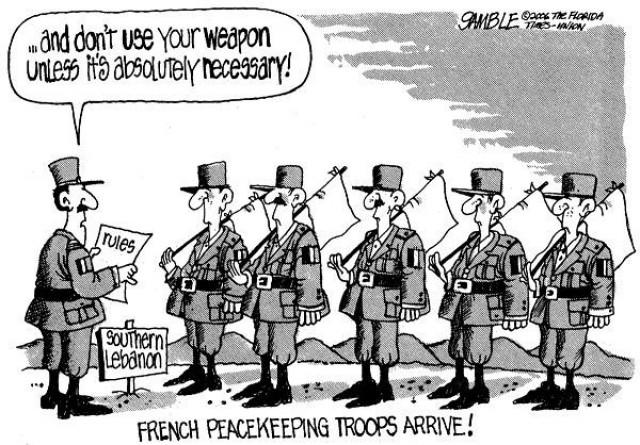
Thanks to CornetJim for this one...T 
Click here for full article
Wednesday, October 04, 2006
Patterns Emerge: A Wellstone Moment?
Here's a piece that I think gets it right (from H.H.). This IM-sex think is big in the media, and has given a little boost to the generic poll #'s, but we still are only looking at a 10 seat loss, max, and it's still a month to election day (15 is the magic number). This is before the backlash begins, and it will! (read on), before the war returns to issue #1, and before the ad campaign hits the Dem's with their votes against Intelligence eavesdropping, against funding for the war, against entitlement reform, in favor of tax increases and impeachment etc....I still predict a maximum 8-10 seat loss in the house and 2-4 seats in the Senate, with the possibility of only 1-2 and 5-6 in the house...T
Reading the comment boards here, it seems some people (especially liberal people) have either short or selective memories when it comes to Paul Wellstone’s funeral. Here’s what happened: A man who was liked and respected by all, including his ideological opponents, died tragically in a plane crash. At his memorial service, Democratic partisans opted to use his metaphorical coffin as a campaign prop while trying to rally the faithful.
If that was all that happened that night, it would have been plenty distasteful. But what made the Wellstone Memorial noteworthy was its raw ugliness. Republican dignitaries who attended the event to show their respect for Wellstone were booed when their images were shown on the Jumbotron. Many fevered-swamp type Democrats saw nothing wrong with this. The country recoiled from the spectacle, utterly repulsed and shocked. To many Democrats, though, the unsightliness of the Wellstone funeral apparently remains an obscure mystery.
The Democratic Party seems intent on replaying this mistake with the Foley affair. Let’s temporarily put aside the timing of the release of the Instant Messages and who-knew-what-when. Let’s just say for the moment that while the media currently hounds the Republican leadership, it’s a safe bet that it wasn’t the Republican leadership that plopped Foley’s IM’s into the lap of ABC News. If whoever was the errand boy delayed delivery to best achieve maximum political benefit, then the Democrats’ newfound status as the party of conventional morality will receive a decided blow.
But the real story here is the party’s eagerness to use victimized children as a campaign prop. The Patty Wettering campaign spot that I linked to earlier today tips the Democrats’ hand. Wettering is best known as a children’s advocate. Her own 16 year old was kidnapped and never found. Thus, Wettering has the proverbial Cindy Sheehan cloak of putative “absolute moral authority” that the simple-minded so admire.
It seems a tad too convenient that Wettering’s campaign is not only serving as the tip of the spear for the Democrats’ Foley offensive, but that the campaign’s ad has grossly distorted the facts of the Foley scandal. Her ad maintains that Foley molested children. One can almost picture Wettering asserting that her absolute moral authority gives her the right to redefine molestation to include things that happen in a virtual realm, and defying anyone to fight her on that ground. And once Wettering defines what happened as “molestation,” the rest of the party will surely follow.
The Wettering campaign’s advertisement also says that congressional leaders “have admitted” to covering up Foley’s antics. There again, Wettering advances the Foley narrative into completely unsupported realms.
WHAT’S UNSEEMLY HERE harkens back to the Wellstone funeral. Although Democrats didn’t realize it at the time and most of them still don’t realize it today, their real sin that night was using a friend’s coffin as a political bludgeon. The old saying is that in America, politics ends at the water’s edge. That saying reflects the fact that most Americans strongly feel that politics belongs in a distinct realm. When a party invites politics to a funeral, it offends the sensibilities of most Americans. It also shows the party doing the inviting to be craven to its core.
The Democrats are now doing the same thing. On the one hand you’ve got Patti Wetterling suggesting that Foley’s crimes were so grave that they should be labeled molestation. On the other hand, you’ve got Wetterling trying to use the victims of those crimes for electoral advantage. As John F. Kennedy once said about Richard Nixon, “No class.”
And speaking of Kennedys, I write this piece about five miles away from Ted Kennedy’s Back Bay mansion. The Senator is probably sleeping in this morning since the Senate’s not in session and he’s running for re-election this Fall essentially unopposed.
But Ted Kennedy remains a living, breathing reminder of why the Democrats’ urgent conversion to the party of traditional values is risibly misguided. So, too, does Patty Wetterling’s latest campaign stumble.
Click here for full article
Who's Really in Denial?
It's not President Bush.
A brief article, but needed now, in the face of the usual pre-election-Dan-Rather-MSM-phony-cooked-up scandal to help the Dem's (Foley, NIE leak, etc)...Anyway; the real issue deciding this election will be the war (as it should be)...T
"Americans face the choice between two parties with two different attitudes on this war on terror." --George W. Bush, September 28, 2006
President Bush is right. It would be nice if he weren't. The country would be better off if there were bipartisan agreement on what is at stake in the struggle against jihadist Islam. But despite areas of consensus, there is still a fundamental difference between the parties. Bush and the Republicans know we are in a serious war. It's not the Bush administration that is in a "State of Denial" (as the new Bob Woodward book has it). It's the Democrats.
Consider developments over the last week. Democrats hyped last Sunday's news stories breathlessly reporting on one judgment from April's National Intelligence Estimate (NIE)--that the war in Iraq has created more terrorists. More than would otherwise have been created if Saddam were still in power? Who knows? The NIE seems not even to have contemplated how many terrorists might have been created by our backing down, by Saddam's remaining in power to sponsor and inspire terror, and the like. (To read the sections of the NIE subsequently released is to despair about the quality of our intelligence agencies. But that's another story.) In any case, the NIE also made the obvious points that, going forward, "perceived jihadist success [in Iraq] would inspire more fighters to continue the struggle elsewhere," while jihadist failure in Iraq would inspire "fewer fighters . . . to carry on the fight."
What is the Democratic response to these latter judgments? Silence. The left wing of the party continues to insist on withdrawal now. The center of the party wants withdrawal on a vaguer timetable.
Bush, on other hand, understands that the only acceptable exit strategy is victory. (If, as Woodward reports, he's been bolstered in that view by Henry Kissinger, then good for Henry. Invite him to the Oval Office more often!) To that end, Bush should do more. He should send substantially more troops and insist on a change of strategy to allow a real counterinsurgency and prevent civil war. But at least he's staying and fighting. And the great majority of Republicans are standing with him. The Democrats, as Bush has put it, "offer nothing but criticism and obstruction, and endless second-guessing. The party of FDR and the party of Harry Truman has become the party of cut-and-run."
So there really is a profound difference between the parties, as Democrats are happy to acknowledge, since they think Iraq is a winning issue for them. The Democratic talking point is this: We're against Bush on Iraq, but we are as resolute as Bush in the real war on terror (understood by them to exclude Iraq). Except that they're not.
That's why last week's votes in Congress on the detainees legislation were so significant. The legislation had nothing to do with Iraq. It was a "pure" war-on-terror vote. And the parties split. Three-quarters of the Democrats in the House and Senate stood with the New York Times and the American Civil Liberties Union for more rights for al Qaeda detainees, and against legislation supported by the Bush administration (as well as by John McCain and Joe Lieberman). Some Democrats in competitive races--such as Rep. Harold Ford, running for the Senate in Tennessee--supported the legislation. But it remains the case that a vote for Democrats is a vote for congressional leaders committed to kinder and gentler treatment of terrorists.
No wonder voters think the country will be safer from terrorism if the GOP retains control of Congress. And no wonder that focus groups--according to the Democratic polling firm of Greenberg Quinlan Rosner--show that "attacks on Democrats for opposing any effort to stop terrorists . . . were highly effective." The Democratic pollsters recommended countering the attacks forcefully. But how? There are votes, in black and white in the Congressional Record, ready to be used in campaign ads.
The most important front in the confrontation with terror-sponsoring, WMD-seeking Islamic jihadism in the next two years may well be Iran. Republicans are viewed by a 12-point margin as the party that would be more likely to prevent Iran from acquiring nuclear weapons. We have been critical of the Bush administration's lassitude in attending to this task. But with sand in the diplomatic hourglass running out, voters can fairly be asked: Would Bush have more help in denying Ahmadinejad nuclear weapons from a Congress controlled by Republicans or by Democrats (whose main suggestion has been to cozy up to Iran without insisting that it verifiably suspend its nuclear program)?
Off-year elections--especially when one party controls the presidency and Congress--are almost always dominated by the expression of grievances with that party's performance. The Bush administration and the congressional leadership have given cause for grievance. But the choice is so stark this November that grievances should be put aside--if Republicans have the nerve to continue to clarify the choice over the next month. Last week was a good start.
Click here for full article
Sunday, October 01, 2006
Campaign 2006: The Republicans' Secret Weapon
You think the GOP is sure to lose big in November? They aren't. Here's why things don't look so bad to them
Even Time magazine (super dribbling liberal) is waking up and smelling the coffee...T
The polls keep suggesting that Republicans could be in for a historic drubbing. And their usual advantage—competence on national security—is constantly being challenged by new revelations about bungling in Iraq. But top Republican officials maintain an eerie, Zen-like calm. They insist that the prospects for their congressional candidates in November's midterms have never been as bad as advertised and are getting better by the day. Those are party operatives and political savants whose job it is to anticipate trouble. But much of the time they seem so placid, you wonder whether they know something.
They do. What they know is that just six days after George W. Bush won re-election in 2004, his political machine launched a sophisticated, expensive and largely unnoticed campaign aimed at maintaining G.O.P. majorities in the House and Senate. If that campaign succeeds, it would defy history and political gravity, both of which ordain that midterm elections are bad news for a lame-duck President's party, especially when the lame duck has low approval ratings. As always, a key part of the campaign involves money—the national Republican Party is dumping at least three times as much into key states as its Democratic counterpart is—but money is only the start. "Panic results when you're surprised," says Republican National Committee (r.n.c.) chairman Ken Mehlman. "We've been preparing for the toughest election in at least a decade."
Thanks to aggressive redistricting in the 1990s and early 2000s, fewer than three dozen House seats are seriously in contention this election cycle, compared with more than 100 in 1994, the year Republicans swept to power with a 54-seat pickup in the House. Then there's what political pros call the ground game. For most of the 20th century, turning out voters on Election Day was the Democrats' strength. They had labor unions to supply workers for campaigns, make sure their voters had time off from their jobs to go to the polls and provide rides to get them there.
Now, though, Democrats are the ones playing catch-up when it comes to the mechanics of Election Day. Every Monday, uberstrategist Karl Rove and Republican Party officials on Capitol Hill get spreadsheets tallying the numbers of voters registered, volunteers recruited, doors knocked on and phone numbers dialed for 40 House campaigns and a dozen Senate races. Over the next few weeks, the party will begin flying experienced paid and volunteer workers into states for the final push. The Senate Republicans' campaign committee calls its agents special teams, led by marshals, all in the service of the partywide effort known as the 72-Hour Task Force because its working philosophy initially focused on the final three days before an election.
So Republicans hope to close the deal in tight races with a get-out-the-vote strategy that was developed in the wreckage of the 2000 presidential campaign. Bush's team was led then, as it is now, by Rove, Bush's political architect and now White House deputy chief of staff, and Mehlman, then White House political-affairs director. Their theory was that Bush lost 3% or 4% of his expected vote in 2000 because those people just stayed home.
What Rove and Mehlman wanted to figure out was the code for increasing the number of Republican voters who could be reliably summoned to the polls—a code that, once cracked, could be used to win election after election. "We want to turn 75%-Republican areas into 78%- or 79%-Republican areas while at the same time turning 15% areas into 18% or 19% areas," says Mike DuHaime, political director of the R.N.C. In the off year of 2001, the creators of the 72-Hour program tested it in odd, lower-profile contests, including court races in Pennsylvania. The Bushies picked clusters of precincts where they quietly tried their new methods, then compared those with similar precincts where the campaigns did things the more traditional way. Those experiments helped Republicans develop a handful of precepts that constitute the party's playbook for this fall:
1. Learn from the past Fifteen G.O.P. data experts spent months after the '04 election comparing turnout records from the swing states with the Bush-Cheney campaign's databases to figure out the optimal amount of mail, phone calls and door knocks that would persuade a probable G.O.P. voter to go to the polls.
2. Draw in new voters The Bush-Cheney campaign used state records to locate potential Republicans with Florida State University license plates, then had fellow Seminoles call them to sound out their views. Whereas parties used to go after certain precincts or zip codes, Republicans now know even which individual households they want through microtargeting—the use of computerized consumer data, from magazine subscriptions to charitable contributions, to help locate voters who are likely to vote Republican if they turn out. Other telltale signs of potential latent Republicanism are snowmobile ownership and enrollment in private schools.
3. Low tech can be better Caller ID, TiVo, cable channels and satellite radio all make it harder to reach voters than it was just a few years ago, increasing the importance of person-to-person appeals, the hallmark of old-fashioned, grassroots campaigns that used to connote an amateur or a low budget. "You clearly have to have TV ads," says White House political-affairs director Sara Taylor, "but for a little less TV, you can buy a whole lot of pizzas and phone lines and salaries for young men and women right out of college" to make phone calls, knock on doors and recruit and manage volunteers.
4. Details, details The shopping list includes everything from chairs to cell phones for hundreds of workers for Republican Party victory committees, whose staffs are charged with creating state turnout machines. TheG.O.P. says their volunteer forces in '04 proved to be more effective than the paid workers contracted by Democrats, unions and Democrat- oriented fund-raising groups. Even Election Day comes sooner for Republicans, who have begun putting a huge effort into locking down absentee voters and vote-by-mail ballots in states that use them.
5. Spend more Republican officials estimate that at the end of August, their committees and campaigns had $235 million to spend in the two-month home stretch, a $58 million advantage over Democrats. The R.N.C. plans to lay out more than $60 million on turnout efforts and advertising vs. the more than $14 million set aside by Democratic National Committee (D.N.C.) chairman Howard Dean. Senator Hillary Clinton of New York, who has been critical of Dean's approach, complained at a D.N.C. fund-raising luncheon in Washington last week that theG.O.P. "is pouring tens of millions of dollars into races, and we're not matching that." House Republican officials contend that many of their Democratic challengers are so little known that they could be buried in an ad blitz. "You hit them, and they fold like a house of cards," a strategist said.
Republicans had begun to feel better about the election recently after Bush got a bump in the polls, reflecting a steady decline in gas prices and a successful effort by the White House to push national-security issues to the top of the news. But by last week G.O.P. operatives were less elated. Newscasts were trumpeting the tales of infighting in Bush's war cabinet told in Bob Woodward's State of Denial, a book full of stories about an Administration pursuing a war with no clue how to go about it. And Representative Mark Foley, a Republican from Florida, resigned after his X-rated Internet chats with teenage boys from the House page program were made public. A safe seat for Republicans was suddenly in jeopardy.
Republicans acknowledge one ominous vulnerability: for more than a decade, the party has benefited from an intensity gap. Stoked by hatred of Bill Clinton or love for George W. Bush, G.O.P. voters have been more certain to vote than Democrats—meaning that the party tends to perform better than the final opinion polls suggest. Representative Rahm Emanuel of Illinois, head of the House Democrats' campaign committee, recently told Time that gap had counted for as much as 5 to 7 points for the Republicans. But he thinks this election year might be different. "Their voters are unhappy," he says. "They're despondent about a failed President."
White House officials also concede they aren't so sure that Republicans will be motivated to go to the polls this year. Of course, expressions of doubt on the part of senior Republicans could be part of another game the G.O.P. plays better than the Democrats do these days: the expectations game. The Republicans are, after all, in the enviable position of being able to lose a lot. As long as they end up keeping control of both houses, they still come out the winner on Election Day.
Click here for full article


 Posts


