

 Stumble It!


Drinking the coolaid...Barack Hussein Obama, hmm, hmm, hmm...


"Hope and change" turned out not to be a liberal call to consider new ways of solving problems. It was not even a conservative slogan to keep all that has worked well in the past.
Instead, Barack Obama proved to be an old-fashioned reactionary. He hoped to change things back to the politically correct 1960s and 1970s way of doing things -- whether it ever worked or not.
Strange as it sounds for a Liberal Fascist/Socialist to be a reactionary, it is nonetheless absolutely true. Remember, that the term "Liberal" was historically used to describe those on the right; the "Classical Liberals". Only after the term "progressive" was discredited by Woodrow Wilson and his disastrous administration, and FDR and Stalin appropriating the label for themselves has the terminology been corrupted.
Notice how they are now back to calling themselves "progressives" now that the word "liberal" has a negative connotation?!
The most dangerous president since Wilson, the most unethical since Clinton, and the most incompetent since Jimmy Carter...T
Barack Obama is the most reactionary president in the recent history of the United States. Obama seems intent on turning back the clock to the good old days of the 1960s and 1970s, when rigid political orthodoxy, not an open mind, once guided government.
Take the economy. The 1980s implosion of communism in Eastern Europe and the former Soviet Union proved that state control of the means of production guaranteed poverty and worse. The current insolvent and fragmenting European Union, and the stagnant economics of the exploding Middle East, remind us that state socialism does not work.
Why, then, would Obama, in horse-and-buggy fashion, go back to such fossilized concepts as absorbing the nation's health care system, increasing the federal government's role in the economy by taking over automobile corporations, borrowing $5 trillion to spend on new entitlements, or proposing an array of much higher taxes -- all in a vain effort to ensure an equality of result?
Almost every key indicator of the current economy -- unemployment, deficits, housing, energy -- argues that Obama's reactionary all-powerful statist approach has only made things far worse.
In a bygone era without full workers' compensation, unemployment insurance and overtime pay, big unions ran the United States. Today less than 7 percent of Americans belong to them.
Yet President Obama wants to block the Boeing aircraft company from opening an assembly plant in South Carolina, on the grounds that it is a right-to-work state and new assembly workers might be free to reject union representation. The administration is now allowing union-backed Democrats in Congress to block free-trade agreements with Colombia, Panama and South Korea in order to limit competition with domestic unionized industries.
Apparently the decades-old idea that globalized free trade encourages competition, enhances productivity, lowers prices for strapped consumers and helps developing nations never existed.
Obama is still bragging about massive federal subsidies to the wind and solar power industries, while making it nearly impossible to obtain new leases for fossil fuel exploration. Yet for all the billions spent, the percentage of new energy produced by subsidized high-cost "green" projects has not changed much.
Meanwhile, revolutionary breakthroughs in the exploration for and recovery of natural gas, oil, tar sands, shale oil and coal deposits in just a year or two have vastly expanded the nation's fossil fuel reserves and the ability to produce clean energy from them.
It turns out that the U.S. may be the world's new Saudi Arabia when it comes to known reserves of all forms of gas, oil and coal. As our president still harps on solar panels and windmills, private enterprise on its own is exploring new ways of powering industries, homes and cars with cheap and plentiful natural gas -- hoping to free us from dependence on OPEC.
On illegal immigration, the president sounds like he's a calcified relic from the 1960s, as he evokes the southern border in terms of civil rights and racial prejudice. Those blinders explain why he recently suggested that Latinos "punish" their supposed conservative "enemies," and quite falsely claimed that the border fence was completed, despite the wish of his Republican opponents supposedly to add moats and alligators. All that rhetoric sounds like it came from a beads and bell-bottoms '60s campus activist, not the 21st century White House.
In the coming decades, the United States will need new legal immigrants -- those of all races and from all places of origin who are skilled and highly educated, or who have capital. The new critical benchmark to keep America competitive will be an immigrant's merit -- not just his race, family ties, proximity to the border, or his use as a pawn in partisan politics.
The United States is now a multiracial society, one never more intermarried and assimilated. Yet this administration still acts as if particular racial groups are forever ossified in amber, and so deserve particular racial set-aside spoils. The attorney general weirdly talks of "my people." The president himself offered a campaign video in 2010 targeted in part to those defined by their race, as part of a larger strategy to appeal to racial block voting. Promises of more federal entitlement money are still couched in thinly veiled racial terms -- as if there is no awareness that five decades of such Great Society programs have done much to ensure dependency and destroy the traditional inner-city family.
"Hope and change" turned out not to be a liberal call to consider new ways of solving problems. It was not even a conservative slogan to keep all that has worked well in the past.
Instead, Barack Obama proved to be an old-fashioned reactionary. He hoped to change things back to the politically correct 1960s and 1970s way of doing things -- whether it ever worked or not.
Full article in new window

Nice to see a REAL businessman speaking out against our socialist/fascist president's policies - at least to this day, he can still be open with his thoughts, as, after all, Obama's intellectual (sic) predecessors FDR and Woodrow Wilson simply had them imprisoned.
The author (who was an enthusiastic Obama supporter in 2008) makes the compelling and unassailable case that it exactly this president's open war against capital that has depressed our economy and will keep it so until he is consigned to the ash-heap of history.
After all, that is also exactly happened in the 30's and 40's under FDR...T
Many commentators blame our continuing economic woes on "uncertainty." They allege that recent and anticipated dramatic policy changes make business planning difficult, and that this is retarding growth and employment. This view is not wrong—but our main problem is not the uncertainty surrounding new policies. It is the policies.
Consider two uncertain situations. In the first, our business is waiting to find out the location decision for a customer's new industrial plant, so we know where to build our new supply facility. Until this is resolved, we will not invest in building nor will we hire staff. In the second situation, we know we are in for some pain, someone is going to make our business less productive and profitable, but we do not yet know how much. Planning is marginally more difficult, but the main reason we will not grow in the second situation is that investment is less attractive regardless of the precise resolution of uncertainty.
In the first case, uncertainty is the obstacle. Once it is resolved, we invest. In the second case, uncertainty is a small part of the problem. The large part is simply that bad things are happening. The day we are told "well, it's exactly a 30% hit to productivity and profits," all uncertainty is resolved—yet we will still not invest or hire.
The Obama administration's economic policies have defenders. For instance, New York Times columnist Paul Krugman will tell you the stimulus helped, and we didn't have enough. I disagree. I will tell you the stimulus was wasteful and politicized, and the American people, not being idiots, know they will have to pay for it eventually. People adjust their plans to account for the additional debt heaped on them, meaning lower investment and consumption.
I will also tell you Dodd-Frank, with its enshrining of too big to fail and its large regulatory costs, is an albatross. I will add that ObamaCare's gigantic new entitlement has hurt. I will throw in that massive additional regulatory costs being foisted upon business is an extra drain on the economy. I would definitely say that the disregard for law during the auto-company "bankruptcies" has long-lasting negative effects. I'd even throw in that the president's demonization of business has been harmful. Finally, I'd say the expected tax increases, even if only on the "super rich"—defined as anyone still gainfully employed—weigh upon us. So what does all this have to do with uncertainty and whether that's our problem? Consider a hypothetical.
Imagine, right now, we passed a giant additional wasteful stimulus. Imagine all the rules of Dodd-Frank were revealed and are even more stifling than we expected. Imagine we doubled the new health-care entitlement and expanded government control of health care more than previously predicted, but set all the details today. Imagine assorted government agencies passed more burdensome regulations than we anticipated, increasing both the cost of doing business and the drag of crony capitalism. But all uncertainty was resolved by passing them today.
Next imagine that the president promised, in no "uncertain" terms, to up his hectoring of business in perpetuity. Further, imagine we passed higher taxes going forward on everyone but, again, we settled it for certain right now. Finally, imagine we committed ourselves to no entitlement reform ever. Is all this good or bad? Well, uncertainty has been eliminated, but it sounds pretty darn bad.
Now let's go the opposite way and consider good policies surrounded by uncertainty. Imagine we will move from here toward free-market health-care reforms appropriate for a free people. We will reduce government spending and our debt, letting people spend their own money as they see fit. We will lower taxes across the board for individuals and businesses, and we'll reduce and simplify deductions.
Imagine even more that we'll make grown-up decisions and reform entitlements to levels we might possibly afford. Now imagine that while we know the direction of each of these policy changes, alas, we are very uncertain about how far these wonderful ideas will go. Imagine this uncertainty is even higher than it is around today's bad policies. Would these changes, uncertainty and all, make things better or worse? Well, it seems pretty clear that should these changes occur in any nontrivial fashion, you would have to duck to get out of the way of the ensuing economic boom, regardless of the uncertainty.
Focusing on "uncertainty" takes our eyes off the ball. We should not seek clarity about the many new drags on our economy. We should seek to have the administration cease and desist, then reverse them.
Mr. Asness is the managing and founding principal of AQR Capital Management
Full article in new window


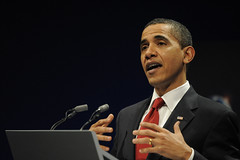 Image by London Summit via FlickrThis is what I have been predicting since his 101's day or so: A dangerous radical, a rank incompetent, or a fatal combination of both. Jimmy Carter finally gets a reprieve as the worst president in 100 years...T
On a recent visit to London I was struck by how much faith many British politicians, journalists and political advisers have in Barack Obama being re-elected in 2012. In the aftermath of the hugely successful Special Forces operation that took out Osama Bin Laden and a modest spike in the polls for the president, the conventional wisdom among political elites in Britain is overwhelmingly that Obama will win another four years in the Oval Office. Add to this a widespread perception of continuing disarray in the Republican race, as well as a State Visit to London that had the chattering classes worshipping at the feet of the US president, and you can easily see why Obama’s prospects look a lot rosier from across the Atlantic.
But back in the United States, the reality looks a lot different. Many political leaders in Britain fail to understand the degree to which the American people are deeply unhappy with their president’s poor handling of the economy. Nor have they grasped the epic scale of the defeat suffered by the president in the November mid-terms, and the emphatic rejection by a clear majority of Americans of the Big Government Obama agenda.
Just seven months ago, the United States was swept by a conservative revolution that fundamentally transformed the political landscape on Capitol Hill, and gravely weakened the ability of the president to pass legislation. This revolution is not in retreat but gaining ground, led by charismatic figures such as Paul Ryan, the Reaganite chairman of the House Budget Committee, entrusted with reining in out of control government spending. And as a Gallup poll showed, America is unquestionably a conservative country ideologically, but one that is ironically led by the most left-wing president in the nation’s history.
Ultimately, the 2012 presidential election will be decided by the state of the economy, and new data released this week makes grim reading for the White House. In fact you cannot watch a US financial news network at the moment, from Bloomberg to CNBC to Fox Business, without a great deal of pessimism about the dire condition of the world’s biggest economy. 66 percent of Americans now worry the federal government will run out of money in the face of towering public debts.
To say this has been an extremely bad week for the Obama administration on the economic front would be a serious understatement. As The Wall Street Journal reported on Wednesday, home prices in the United States have sunk to their lowest levels since 2002, falling 4.2 percent in the first quarter of 2011. At the same time, employment growth is stalling, with only 38,000 Americans added to the workforce in May, the smallest increase since September. This compares with 179,000 jobs added in April. There has also been a steep slowdown in the manufacturing sector, and a downturn in the stock market on the back of weak economic news.
Bill Clinton’s labour secretary Robert Reich summed up the grim mood in a hard-hitting op-ed in The Financial Times, which took aim at both the administration and Congress:
The US economy was supposed to be in bloom by late spring, but it is hardly growing at all. Expectations for second-quarter growth are not much better than the measly 1.8 per cent annualised rate of the first quarter. That is not nearly fast enough to reduce America’s ferociously high level of unemployment… Meanwhile, housing prices continue to fall. They are now 33 per cent below their 2006 peak. That is a bigger drop than recorded in the Great Depression. Homes are the largest single asset of the American middle class, so as housing prices drop many Americans feel poorer. All of this is contributing to a general gloominess. Not surprisingly, consumer confidence is also down.
Unsurprisingly, the polls are again looking problematic for the president. The latest Rasmussen Presidential Tracking Poll shows just 25 percent of Americans strongly approving of Obama’s performance, with 36 percent strongly disapproving, for a Presidential Approval Index rating of minus 11 points. In a projected match up between Obama and a Republican opponent, the president now trails by two points according to Rasmussen – 43 to 45. The RealClear Politics poll of polls shows just over a third of Americans (34.5 percent) agreeing that the country is heading in the right direction, with nearly three fifths (56.8 percent) believing it is heading down the wrong track. That negative figure rises to a staggering 66 percent of likely voters in a new Rasmussen survey, including 41 percent of Democrats.
There is no feel good factor in America at the moment. But there is a great deal of uncertainty, nervousness, even fear over the future of the world’s only superpower. This is hardly a solid foundation for a presidential victory for the incumbent. Even though we don’t know yet who he will be up against, Barack Obama could well go into 2012 as the underdog rather than the favourite he is frequently portrayed as. On balance we’re likely to see a very close race 17 months from now. But there is also the distinct possibility of an electoral rout of the president if the economy goes further south. “Hope and change” might have played well in 2008, but it is a message that will likely ring hollow in November 2012, with an American public that is deeply disillusioned with the direction Obama is taking the country.
Full article in new window

"The only remaining question is whether this perverse and ultimately self-defeating policy is born of genuine antipathy toward Israel or of the arrogance of a blundering amateur who refuses to see that he is undermining not just peace but the very possibility of negotiations."

"I be wearin me lucky chains! (er, charms...)"
The only president to accomplish the impossible: Make Bill Clinton look ethical, and Jimmy Carter competent by comparison...T
Ah Bejaysus and Begorrah! Oi’ll be swearin’ boi the auld shrine to the Vorgin with the shamrocks growin’ round it next to the hill where Cuchullain slew the Great Leprechaun of Kildare on St Patrick’s Day that Barack Seamus O’Toole Flaherty Joyce O’Bama is the most Irish US president that ever set foot on the Emerald Oisle, so he is, so he is.
Except, when he’s in Africa, of course, when he disappears into the dry ice and re-emerges with a grass skirt and a bone through his nose and declares himself to be Mandingo, Prince of the Bloodline of the Bonga People, Drinker of Cattle Urine, Father of A Thousand Warrior Sons, Keeper of King Solomon’s Mines, Barehanded Slayer of Lions, Undaunted Victim of the Evil Colonial British Empire.
And in the Middle East, where he is Al-Barak Hussein Obama, Protector of the Holy Shrine, Smiter of the Kuffar, Lion of the Desert, Tent-Loving-Aficionado-of-the-Oversweetened-Coffee, Chomper of Sheeps’ Eyeballs, Restorer of the Caliphate.
Etc.
Tony Blair used to do this trick too, his accent mutating from broad Glaswegian to genteel Edinburgh to Mummerset to Estuary to Richard E Grant to Sarf London Grime – often in the course of one Downing Street reception – the better to persuade his target audience that he was their kind of guy. And it is, of course, the hallmark of an unutterable charlatan.
I’ve argued before that Tony Blair and Barack Obama have an awful lot in common. Both are lawyers; both are snake-oil-salesman; both claim to be post-partisan, and Third Way and consensual; both play the acceptable, moderate-seeming public face of a regime chock full of Communists, class warriors, single issue rabble rousers, malcontents, communitarians and eco-loons hell bent on destroying every last vestige of what once made their country great. And both do (or did) the things dodgy political leaders always do when the going gets tough at home and their domestic audience finally wises up to how totally useless they are: they hop on the plane and pose as international statesman instead.
My colleague Damian Thompson appears to be under the impression that Obama is a great guy because he said nice things about the Queen. Look, I think the Queen’s great too, but did it really not occur to my distinguished colleague (and editor) that there might have been a hint of an ulterior motive here? Obama can’t stand Britain (his wife likes us even less): he made that clear enough when he sent back Winston Churchill’s bust and dissed our Prime Minister with those dodgy DVDS. He blames us for what happened to his grandfather during Mau Mau. He doesn’t believe in the Special Relationship. Are we honestly supposed to believe in that during the subsequent year in office, Obama has since acquired such wisdom and insight that he suddenly realises how special we are?
Of course he hasn’t. Obama is just doing now what all bullies and losers start doing when they realise how unpopular they are and that everyone is abandoning them. They suck up to anybody and everybody. They whore themselves piteously before enemies they once considered beneath their contempt. Fain will they fill their bellies with husks that swine eat – but which no man will give them: and serve them jolly well right, too!
By all means let us enjoy watching Obama smarm and grovel and ingratiate himself like some presidential Uriah Heep. But for heaven’s sake let us never give him the benefit of the doubt. He’s a cold fish and would certainly never show any mercy towards us were the roles to be reversed
Full article in new window


Thank God for George W. Bush, who implemented the practices that have kept us safe, Killed Obama Bin Laden, and defeated the Islamo-Fascists!
Osama bin Laden is dead. The Middle East is in chaos. And radical Islam is floundering.
For a time after 9/11, bin Laden was riding high. Destroying 16 acres in Manhattan and hitting the Pentagon won al-Qaeda even more admiration from the Arab Street, hidden cash donations from sympathetic petrol-sheiks, and bribe and hush money from triangulating Middle East dictatorships.
But now bin Laden and most of his henchmen of a decade ago are dead, like the bloodthirsty Abu Musab al-Zarqawi, killed by American forces in Iraq. Or they were captured, like the 9/11 architect Khalid Sheikh Mohammed in Pakistan. Or they are in hiding, like Dr. Ayman al-Zawahiri, the increasingly irrelevant blowhard al-Qaeda information minister.
What caused al-Qaeda's steady decline? There are a lot of reasons.
Right after 9/11, the United States crafted a set of antiterrorism protocols as sweeping as they were controversial: the Patriot Act, Guantanamo Bay, renditions, tribunals, preventative detention, intercepts, wiretaps and enhanced interrogations. New security measures filtered down to every facet of American life, from radically intrusive and unpopular airport protocols that X-rayed baggage and passengers to beefed-up security on trains and at ports.
Civil libertarians mocked such vigilance, but the message went out that it was now much harder to come to America from the Middle East and in anonymity plan another 9/11. Subsequent terrorist attempts, aimed at targets such as the Brooklyn Bridge and Times Square, either failed or were thwarted before they began.
In wars abroad, thousands of radical Islamic jihadists heeded bin Laden's call to arms and flocked to the Hindu Kush and Anbar Province. The United States military and its allies were waiting, and then killed or wounded many thousands of terrorists and insurgents. That indisputable fact is as little remarked upon as it was critical to weakening and discrediting the martial prowess of radical Islam.
We also forget that the removal of Saddam Hussein, followed by his trial and execution by a democratically elected Iraq government, set off initial ripples of change in the Middle East between 2004 and 2006. The Syrian army was pushed out of Lebanon by popular protests. Muammar Gadhafi surrendered his nuclear weapons and publicly worried about his own future. Pakistan abruptly arrested for a time A.Q. Khan, who had franchised his nuclear weapons expertise.
These events did not lead directly to the current popular protests throughout the Middle East, but they may well have been precursors of a sort, once Iraq's elected government survived and the violence there abated.
But there is a final development that caused headaches for radical Islam -- the end of the American hysteria over the legality and morality of its own antiterrorism measures.
Although candidate Barack Obama was elected as the anti-Bush who promised to repeal the Bush protocols and end the wars in Afghanistan and Iraq, President Obama did no such thing. He continued the Bush-Petraeus withdrawal plan in Iraq. He escalated in Afghanistan. He kept all the antiterrorism measures that he had once derided. And he expanded the Predator drone assassination missions fivefold, while sending commandos inside Pakistan to kill -- not capture and put on trial -- bin Laden. He ignored most recommendations from Attorney General Eric Holder and guessed rightly that his own left-wing base would keep largely quiet.
The effect was twofold. America kept up the pressure on terrorists and their supporters. And the liberal opposition to our antiterrorist policies simply evaporated once Obama became commander in chief.
Some who once protested the removal of Saddam lauded the efforts to do the same to Gadhafi. Those who once sued on behalf of detainees at Guantanamo joined the government to ensure the Predator drone targeted-killing program continued.
The chances in 2012 that the buffoonish Michael Moore -- who once praised the Iraqi insurgents -- will be again feted as a guest of honor at the Democratic National Convention, as he was in 2004, or that Cindy Sheehan will grab headlines once again, are zero.
Polls show that Obama's America is still just as unpopular among Middle Easterners as it was under George W. Bush. But now a much different media assumes that the problem is theirs, not America's. In this brave new world, the American liberal community is now invested in the continuance of the once-despised Bush antiterrorism program and the projection of force abroad -- and has little sympathy for foreign criticism of an American president.
Quite simply, bin Laden's world of 2001 no longer exists. That's mostly good for us, but quite bad for the dead terrorist's followers.
Full article in new window

 Image via Wikipedia The Civil War did great good. We must not forget, however, that it also damaged our nation in ways that have never been repaired. A must read!
The Civil War represents the simultaneous culmination and repudiation of the American Revolution. Four successive ideological surges had previously defined American politics: the radical republican movement that had spearheaded the revolution itself; the subsequent Jeffersonian movement that had arisen in reaction to the Federalist State; the Jacksonian movement that followed the War of 1812; and the abolitionist movement. Although each was unique, each in its own way was hostile to government power. Each had contributed to the long-term erosion of all forms of coercive authority.
“Nowhere was the American rejection of authority more complete than in the political sphere,” writes historian David Donald. “The decline in the powers of the Federal government from the constructive centralism of George Washington’s administration to the feeble vacillation of James Buchanan’s is so familiar as to require no repetition here. . . . The national government, moreover, was not being weakened in order to bolster state governments, for they too were decreasing in power. . . . By the 1850s the authority of all government in America was at a low point.”
The United States, already one of the most prosperous and influential countries on the face of the earth, had practically the smallest, weakest State apparatus.
The great irony of the Civil War is that all that changed at the very moment that abolition triumphed. As the last, great coercive blight on the American landscape, black chattel slavery, was finally extirpated—a triumph that cannot be overrated—the American polity did an about-face.
Insofar as the war was fought to preserve the Union, it was an explicit rejection of the American Revolution. Both the radical abolitionists and the South’s fire-eaters boldly championed different applications of the revolution’s purest principles. Whereas the abolitionists were carrying on the assault against human bondage, the fire-eating secessionists embodied the tradition of self-determination and decentralized government. As a legal recourse, the legitimacy of secession was admittedly debatable. Consistent with the Antifederalist interpretation of the Constitution that had come to dominate antebellum politics, secession undoubtedly contravened the framers’ original intent. But as a revolutionary right, the legitimacy of secession is universal and unconditional. That at least is how the Declaration of Independence reads. “Put simply,” agrees William Appleman Williams, “the cause of the Civil War was the refusal of Lincoln and other northerners to honor the revolutionary right of self-determination—the touchstone of the American Revolution.”
American nationalists, then and now, automatically assume that the Union’s breakup would have been catastrophic. The historian, in particular, “is a camp follower of the successful army,” Donald wrote, and often treats the nation’s current boundaries as etched in stone. But doing so reveals a lack of historical imagination. Consider Canada. The United States twice mounted military expeditions to conquer its neighbor, first during the American Revolution and again during the War of 1812. At other times, including after the Civil War, annexation was under consideration, sometimes to the point of private support for insurgencies similar to those that had helped swallow up Florida and Texas. If any of these ventures had succeeded, historians’ accounts would read as if the unification of Canada and the United States had been fated, and any other outcome inconceivable. In our world, of course, Canada and the United States have endured as separate sovereignties with hardly any untoward consequences. “Suppose Lincoln did save the American Union, did his success in keeping one strong nation where there might have been two weaker ones really entitle him to a claim to greatness?” asks David M. Potter. “Did it really contribute any constructive values for the modern world?”
The common refrain, voiced by Abraham Lincoln himself, that peaceful secession would have constituted a failure for the great American experiment in liberty, was just plain nonsense. “If Northerners . . . had peaceably allowed the seceders to depart,” the conservative London Times correctly replied, “the result might fairly have been quoted as illustrating the advantages of Democracy; but when Republicans put empire above liberty, and resorted to political oppression and war rather than suffer any abatement of national power, it was clear that nature at Washington was precisely the same as nature at St. Petersburg. . . . Democracy broke down, not when the Union ceased to be agreeable to all its constituent States, but when it was upheld, like any other Empire, by force of arms.” “
War is the health of the State,” proclaimed Randolph Bourne, the young Progressive, disillusioned by the Wilson administration’s grotesque excesses during World War I. Bourne’s maxim is true in two respects. During war itself the government swells in size and power, as it taxes, conscripts, regulates, generates inflation, and suppresses civil liberties. Second, after the war there is what economists and historians have identified as a ratchet effect. Postwar retrenchment never returns government to its prewar levels. The State has assumed new functions, taken on new responsibilities, and exercised new prerogatives that continue long after the fighting is over. Both of these phenomena are starkly evident during the Civil War.
Before Fort Sumter national spending was only about $2.50 per person per year, or $50 per person in today’s prices. The central government relied on only two sources of revenue: a very low tariff and the sale of public lands. The war brought not only protectionist import duties but also a vast array of internal excises, the country’s first national income tax, and an extensive internal revenue bureaucracy with 185 districts reaching into every hamlet and town. Federal outlays soared from 1.5 percent of the economy’s output to almost 20 percent, approximately what the central government spends today. The national debt climbed from a modest $65 million, less than annual expenditures, to $2.8 billion. This provided the justification for replacing the antebellum monetary system of free banking and financial deregulation (which some economic historians believe was the best the country has ever had) with inflationary fiat money and nationally regulated banking.
Protectionism would continue to dominate U.S. trade policy mercilessly until the Great Depression and was just one manifestation of the Lincoln administration’s effort to enlist special interests through government subsidies and privileges. The Yankee Leviathan also was responsible for the first federal aid to transcontinental railroads, land grants for higher education, a Department of Agriculture for farmers, and troops to break strikes for employers. The prewar regime of Jacksonian laissez faire was effectively supplanted by Republican neomercantilism, an alliance between business and government that became so scandalous during the Grant era that it has gone down in history as, to use Vernon Louis Parrington’s label for the postwar feeding frenzy, the “Great Barbecue.”
Lincoln’s war delivered a blow to civil liberties as well. The Union’s resort to nationally administered conscription touched off so much resistance that the President suspended habeas corpus throughout the North. Traditional estimates are that the administration imprisoned without trial or charges 14,000 civilians during the conflict, but some historians believe the figure to be much too low. To be sure, the greater number were citizens of either the border states or the Confederacy itself, and many of those arrested secured quick release within a month or two, usually after swearing a loyalty oath. Yet the federal government at the same time monitored and censored both the mails and telegraphs and shut down over 300 newspapers for varying periods.
Many of these measures were of course abandoned at the fighting’s end. Federal spending fell from its wartime peak to only 3 to 4 percent of GDP. Although not a trivial decline, it still left spending at twice prewar levels, and the largest postwar expenditures were war-related. Interest on the war debt initially accounted for 40 percent of federal outlays, and by 1884 veterans’ benefits were consuming 30 percent. These benefits were so lavish that they constitute the national government’s first old-age and disability insurance and stand as a precursor to Social Security. The impact of the Civil War was even felt in the seemingly unrelated area of obscenity. Congress passed the first act regulating mail content in response to complaints that troops were ordering pornographic material, and this became the basis for the Comstock witch hunts of the 1870s.
The Real Turning Point
This ratchet effect is a phenomenon historians frequently observe. Yet the Civil War did something more. Despite wars and their ratchets, governments must sometimes recede in reach, else all would have been groaning under totalitarian regimes long ago. Both conservatives and so-called liberals date the major political turning point in American history at the Great Depression of 1929. Previously Americans are supposed to have self-reliantly resisted the temptations of government largess and confined federal power within strict constitutional limits. Although Franklin D. Roosevelt’s New Deal is responsible for Social Security, which along with health care, now ranks as the national government’s primary expense, this legend ignores several inconvenient facts. To begin with, the New Deal simply emulated the Wilson administration’s previous war collectivism. Moreover the growth of government under the New Deal was trivial compared to its growth during the United States’ next major conflict: World War II.
More astute analysts push the watershed in U.S. history back to the Progressive Era. Progressivism emerged at the beginning of the twentieth century as a diverse inclination, varying in different parts of the country and including members of all political parties. But it became the country’s first dominant mindset to advocate government intervention in the free market and in personal liberty at every level and in every sphere. My contention, however, is that America’s decisive transition must be dated even earlier.
The Yankee Leviathan co-opted and transformed abolitionism. It shattered the prewar congruence among anti-slavery, anti-government, and anti-war radicalism. It permanently reversed the implicit constitutional settlement that had made the central and state governments revenue-independent. It acquired for central authority such new functions as subsidizing privileged businesses, managing the currency, providing welfare to veterans, and protecting the nation’s “morals”—at the very moment that local and state governments were also expanding. And it set dangerous precedents with respect to taxes, fiat money, conscription, and the suppression of dissent.
These and the countless other changes mark the Civil War as America’s real turning point. In the years ahead, coercive authority would wax and wane with year-to-year circumstances, but the long-term trend would be unmistakable. Henceforth there would be few major victories of Liberty over Power. In contrast to the whittling away of government that had preceded Fort Sumter, the United States had commenced its halting but inexorable march toward the welfare-warfare State of today. Full article in new window

Since publication of this article, in fact there has been a 2011 budget deal, concluded almost entirely on republican conservative terms, unless you believe Dick Morris. Our side is playing the game at last, from Wisconsin to Washington...it's about time, and play ball!...T
One of the things that fascinates me about American politics is how the voices of the voters as registered in elections and polls are transformed into changes in public policy. It's a rough and ready process, with plenty of trial and error. But for all its imperfections the political market seems to work.
Three developments during the past week illustrate this process. Developments, not results, because each is part of an ongoing struggle that will not be resolved soon.
The first was Tuesday's election for the Wisconsin Supreme Court.
Democrats and public employee unions rallied against the bill sponsored by Republican Gov. Scott Walker and passed by the legislature scaling back public employee unions' bargaining privileges and stopping the automatic flow of dues money from the state treasury to the unions and their allies in the Democratic Party.
The public employee unions hoped to defeat a Republican Supreme Court justice and create an activist liberal majority that might overturn the law. Turnout increased from 793,000 in April 2009 to 837,000 in the February 2011 primary to 1,494,000 last week, and examination of the returns shows big increases where unions are strong.
But the anti-spending enthusiasm that brought so many conservatives to the polls in November was still operative in April, and the Republican seems to have won by 7,000 votes. And Democrats' efforts to recall Republican state senators seem unlikely to net them the three seats they need for a majority.
A maximum effort by the unions, combined with Republican hamhandedness, was not quite enough to reverse last fall's result in a state Barack Obama carried by 56 to 42 percent.
The second development was House Budget Committee Chairman Paul Ryan's unveiling of his budget resolution. Ryan did what Barack Obama's Fiscal Commission did in December but what Obama himself signally failed to do in his budget in February: address the long-term unsustainability of entitlements, specifically Medicare and Medicaid.
Every serious analyst knows that these programs are on a trajectory to balloon government to a share of gross domestic product unprecedented except in World War II. The Fiscal Commission proposed both increased taxes and program changes that would cut spending. Ryan proposed such program changes plus other spending and tax cuts.
The House seems sure to pass Ryan's budget and Republican presidential candidates are likely to embrace similar proposals. None of this would have happened -- and didn't happen during the Bush years -- but for public reaction to the Obama Democrats' policies.
The third development is the budget struggle over spending in the remainder of fiscal 2011. At this writing, it was not clear whether negotiations between Speaker John Boehner and Senate Majority Leader Harry Reid would avert a government shutdown that both say they don't want.
What is clear is that there already have been significant cuts in domestic discretionary spending -- far more than the Democratic Congress would ever have considered in 2010 -- and that there will be more to come.
Congressional Democratic leaders could have avoided this by passing a budget resolution and appropriations in 2010 and by increasing taxes on high earners by extending the Bush tax cuts for everyone else. But despite their large majorities they never got around to doing so. Instead they watched glumly as Obama agreed to extend all the tax cuts in December, and they're now negotiating billions in cuts they would never have countenanced last year
Why? Because of public opinion, as registered in poll responses to the Democrats' vast expansion of the size and scope of government symbolized by, but not limited to, the February 2009 stimulus package and Obamacare.
As a result, Democratic leaders dared not ask their members to vote for the policies they favored. Despite their large majorities, they just didn't have the votes.
Obama's refusal to address entitlement issues now has a similar basis. He wants spending to continue on its upward trajectory and tax rates to be increased. There is an intellectually serious argument for this: We're an aging country that needs to spend more on health care and we'll just have to settle for less economic growth, as Europe has done.
But status quo and stagnation are not an appealing platform, especially for one who campaigned as the candidate of hope and change. Democrats are playing defense, hoping for a shift of opinion. So far it hasn't happened Full article in new window


 Image via Wikipedia "President Obama gives off a sense of world-weariness and exhaustion with America’s leadership — and has earned a Nobel Peace Prize as a result. He reflects the deep vein of declinism running through the country’s elite, the same class of people who pronounced the presidency uninhabitable just as Ronald Reagan arrived to prove them wrong.
Today, as in the late 1970s, the job isn’t too big, nor is the country too powerful: The man is too small."
As has been posted numerous times on this site, as elsewhere, the comparisons to the feebly inept Jimmy Carter presidency are too glaring to ignore. The only question remaining becomes: Who shall step forward as our new Reagan, and restore our nation from the devastation of his predecessor, as did his namesake?...T
It was fashionable at the end of the 1970s, after a dreary parade of presidential failures punctuated by Jimmy Carter, to say the presidency had grown too unwieldy. The historian Barbara Tuchman spoke for all the academic and journalistic believers in the theory of the impossible presidency when she mused, “Maybe some form of plural executive is needed, such as they have in Switzerland.”
Ah, yes, the wonders of the plural executive. Why didn’t that occur to James Madison?
Pres. Barack Obama has belatedly joined the ranks of presidential fatalists. The job isn’t too complex necessarily; it’s too damn influential. According to the New York Times, Obama has been telling aides that it’d be easier to be president of China. No one hangs on Hu Jintao’s every word, or expects global leadership from a grasping, one-party state that has never been a beacon to the world.
In the history of presidential lamentations, this has to rank among the most pathetic. It brings to mind the affecting scene from The King’s Speech when Colin Firth, playing the stammering monarch-to-be, breaks down and weeps at the prospect of the crown being thrust upon him: “I’m not a king.” Except Barack Obama campaigned for two years straight to be president of the United States — and doesn’t stutter.
The proximate cause of Obama’s angst is the crisis in Libya. Obama announced that Moammar Qaddafi must go, and proceeded to do nothing that might give his words any bite. The administration is still agonizing over the no-fly zone, even as Qaddafi routs the rebels. The no-fly zone isn’t a panacea — realistically, it’d only be a way station to more robust military action. Perhaps the administration wants to rule it out. Fine. But decide already. If Obama wasn’t going to aid the rebels in any way — not even recognize their provisional government, not even arm them — he should have modulated his words accordingly.
Obama lacks executive flair. Talk to New Jersey governor Chris Christie and he will tell you at length how much he loves making decisions. It’s hard to imagine a Chris Christie enjoying life as a legislator. Obama came to the presidency after a political career spent marinating in senates, first in Illinois, then in Washington.
Osama bin Laden famously talked of the weak horse and the strong horse. Obama is the show horse. As a U.S. senator, he distinguished himself more by saying things than by passing legislation. In the White House, he has replicated his role as the non-legislating legislator on a grand scale. His successes have been as the leader of the Democrats in Congress, although even here, the word “leader” applies only loosely. He set the broad goals and gave the speeches; otherwise, he let Nancy Pelosi and Harry Reid run riot.
The stakes of Obama’s self-imposed passivity aren’t as dire as those of Pres. James Buchanan, who pleaded powerlessness as the country fell apart around him on the cusp of the Civil War. William Seward commented acerbically: “[He] shows conclusively that it is the duty of the president to execute the laws — unless somebody opposes him; and that no state has a right to go out of the Union — unless it wants to.” Nor has President Obama reached the depths of a Jimmy Carter, who literally disappeared in the run-up to his infamous 1979 “malaise” speech.
At the dawn of America’s global power, a bumptious Theodore Roosevelt raced to make America’s influence felt around the world — and earned a Nobel Peace Prize as a result. President Obama gives off a sense of world-weariness and exhaustion with America’s leadership — and has earned a Nobel Peace Prize as a result. He reflects the deep vein of declinism running through the country’s elite, the same class of people who pronounced the presidency uninhabitable just as Ronald Reagan arrived to prove them wrong.
Today, as in the late 1970s, the job isn’t too big, nor is the country too powerful: The man is too small.
Full article in new window

Hell yeah! Could this be, finally, the end of the progressive movement's ascendancy in real terms, in America? Reagan, Newt, and Bush all had them on the ropes, but now the nation is in full throated revolt, and there may - MAY - be no caving in this time. Very courageous leaders in DC, Wisconsin, Ohio and Indiana...T
The magnificent turmoil now gripping statehouses in Wisconsin, Ohio, Indiana and soon others marks an epic political moment. The nation faces a fiscal crisis of historic proportions and, remarkably, our muddled, gridlocked, allegedly broken politics have yielded singular clarity.
At the federal level, President Obama's budget makes clear that Democrats are determined to do nothing about the debt crisis, while House Republicans have announced that beyond their proposed cuts in discretionary spending, their April budget will actually propose real entitlement reform. Simultaneously, in Wisconsin and other states, Republican governors are taking on unsustainable, fiscally ruinous pension and health-care obligations, while Democrats are full-throated in support of the public-employee unions crying, "Hell, no."
A choice, not an echo: Democrats desperately defending the status quo; Republicans charging the barricades.
Wisconsin is the epicenter. It began with economic issues. When Gov. Scott Walker proposed that state workers contribute more to their pension and health-care benefits, he started a revolution. Teachers called in sick. Schools closed. Demonstrators massed at the capitol. Democratic senators fled the state to paralyze the Legislature.
Unfortunately for them, that telegenic faux-Cairo scene drew national attention to the dispute - and to the sweetheart deals the public-sector unions had negotiated for themselves for years. They were contributing a fifth of a penny on a dollar of wages to their pensions and one-fourth what private-sector workers pay for health insurance.
The unions quickly understood that the more than 85 percent of Wisconsin not part of this privileged special-interest group would not take kindly to "public servants" resisting adjustments that still leave them paying less for benefits than private-sector workers. They immediately capitulated and claimed they were only protesting the other part of the bill, the part about collective-bargaining rights.
Indeed. Walker understands that a one-time giveback means little. The state's financial straits - a $3.6 billion budget shortfall over the next two years - did not come out of nowhere. They came largely from a half-century-long power imbalance between the unions and the politicians with whom they collectively bargain.
In the private sector, the capitalist knows that when he negotiates with the union, if he gives away the store, he loses his shirt. In the public sector, the politicians who approve any deal have none of their own money at stake. On the contrary, the more favorably they dispose of union demands, the more likely they are to be the beneficiary of union largess in the next election. It's the perfect cozy setup.
To redress these perverse incentives that benefit both negotiating parties at the expense of the taxpayer, Walker's bill would restrict future government-union negotiations to wages only. Excluded from negotiations would be benefits, the more easily hidden sweeteners that come due long after the politicians who negotiated them are gone. The bill would also require that unions be recertified every year and that dues be voluntary.
Recognizing this threat to union power, the Democratic Party is pouring money and fury into the fight. Fewer than 7 percent of private-sector workers are unionized. The Democrats' strength lies in government workers, who now constitute a majority of union members and provide massive support to the party. For them, Wisconsin represents a dangerous contagion.
Hence the import of the current moment - its blinding clarity. Here stand the Democrats, avatars of reactionary liberalism, desperately trying to hang on to the gains of their glory years - from unsustainable federal entitlements for the elderly enacted when life expectancy was 62 to the massive promissory notes issued to government unions when state coffers were full and no one was looking.
Obama's Democrats have become the party of no. Real cuts to the federal budget? No. Entitlement reform? No. Tax reform? No. Breaking the corrupt and fiscally unsustainable symbiosis between public-sector unions and state governments? Hell, no.
We have heard everyone - from Obama's own debt commission to the chairman of the Joint Chiefs of Staff - call the looming debt a mortal threat to the nation. We have watched Greece self-immolate. We can see the future. The only question has been: When will the country finally rouse itself?
Amazingly, the answer is: now. Led by famously progressive Wisconsin - Scott Walker at the state level and Budget Committee Chairman Paul Ryan at the congressional level - a new generation of Republicans has looked at the debt and is crossing the Rubicon. Recklessly principled, they are putting the question to the nation: Are we a serious people?
Full article in new window


 Posts
All Comments
Posts
All Comments


